Jul 2026
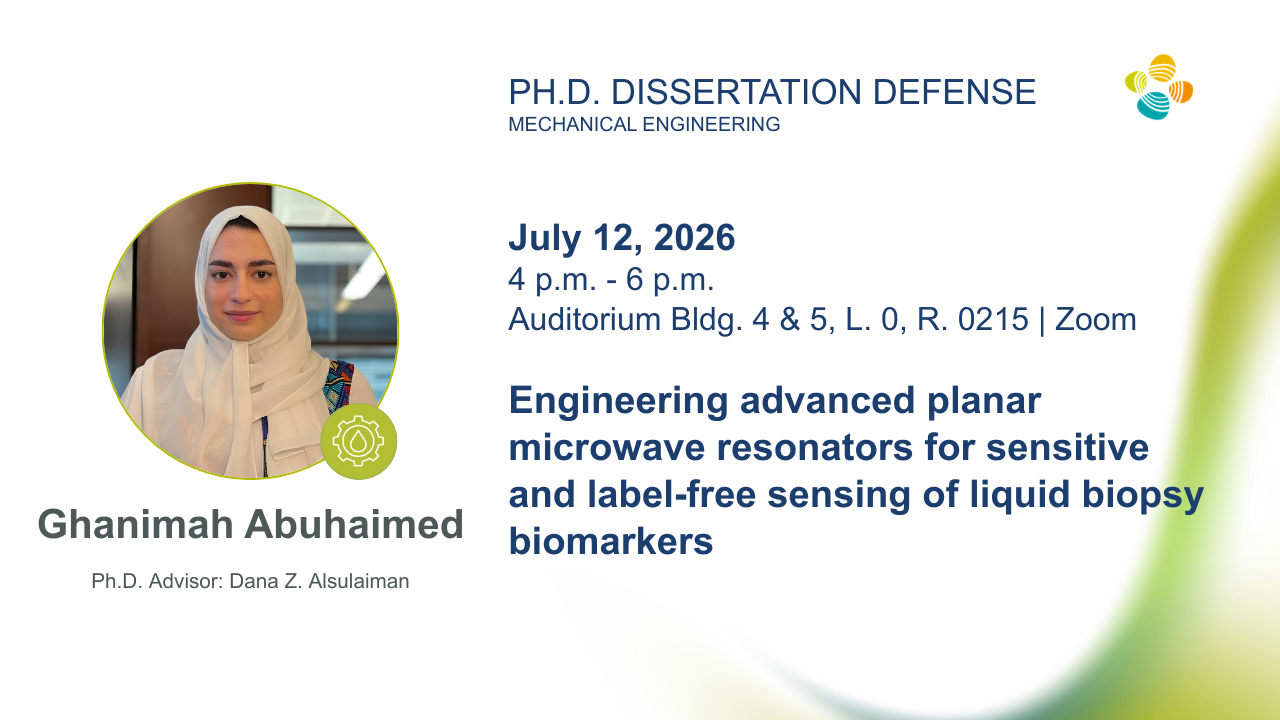
Engineering Advanced Planar Microwave Resonators for Sensitive and Label-free Sensing of Liquid Biopsy Biomarkers
Zoom link: https://kaust.zoom.us/j/97978793682
Thesis Committee:
- Prof. Nazek Elatab (Chair)
- Prof. Tadd Truscott (ME Examiner)
- Prof. Dana Alsulaiman (Advisor)
- Prof. Gameel Saleh (External Examiner)
- Prof. Amal Hajjej
Abstract
Early and accurate detection of disease-associated biomarkers at the point of care (POC) is essential for improving health outcomes, particularly in resource-limited settings. Gold-standard assays such as RT-qPCR and ELISA offer excellent sensitivity and specificity but are complex, time- and reagent-intensive, and confined to centralized laboratories. Emerging electrical POC biosensors (BioFETs, impedimetric, and capacitive platforms) are compact and label-free but fundamentally constrained by direct electrode–sample contact, which promotes biofouling, drift, and strong dependence on electrolyte composition. Planar microwave resonators provide label-free dielectric sensing with potential for non-contact interrogation, scalable PCB-based fabrication, and straightforward RF readout, yet their broader translation has been limited by modest intrinsic sensitivity, incomplete biochemical specificity, and challenges in engineering robust biointerfaces.
This thesis addresses these limitations by developing planar microwave biosensing platforms and interfaces for clinically relevant liquid biopsy targets, focusing on cancer-related microRNAs (miRNAs) and antibodies. Chapter 2 surveys liquid biopsy biomarkers, gold-standard methods, and POC biosensing technologies, identifying gaps in translating dielectric microwave sensing into robust diagnostics. Chapters 3–5 present three complementary experimental advances.
Chapter 3 introduces a weakly coupled, high-Q interdigitated capacitive split-ring resonator (SRR) functionalized with phosphonic-acid–anchored peptide nucleic acid (PNA) probes for label-free detection of cancer-associated miRNAs. The oxide-compatible chemistry enables stable, oriented PNA immobilization, and the interdigitated geometry localizes the electric field within the sensing gap, yielding fit-for-purpose sensitivity at clinically relevant (fM–pM) levels.
In Chapter 4, we developed a novel configuration for microwave biosensing by extending it to three-dimensional sensing via probe-functionalized hydrogel micropillar biointerfaces on planar SRRs. Photopatterned PEG-based hydrogel micropillars, embedded with PNA and placed at field maxima, volumetrically increase probe loading and enhance field–analyte overlap. Comparative studies show improved sensitivity, signal-to-noise ratio, and dynamic range versus planar functionalization, without enzymatic amplification or labels.
Chapter 5 generalizes the hydrogel-enabled microwave strategy to serological targets by engineering a complementary SRR with a modular, hydrogel-based antigenic peptide-functionalized interface for label-free antibody detection, as demonstrated with rabbit IgG antibodies. Specific binding within high-field regions produces robust dielectric perturbations over clinically relevant concentration ranges.
Collectively, this work advances planar microwave biosensing toward chemically specific, volumetrically engineered biointerfaces suitable for liquid biopsy diagnostics and practical, reusable POC systems.
Biography
Ghanimah Abuhaimed is a Ph.D. candidate in Mechanical Engineering at KAUST, specializing in RF biosensing technology. She holds a master’s degree from KAUST and a bachelor’s degree in Physics from the University of Colorado Boulder, where she was named to the Dean’s List. Her achievements include receiving the KAUST Gifted Student Program Scholarship, the prestigious Qimam Fellowship, second place in the Water Hackathon, and selection for Project1932 Little Sib program. She has also demonstrated leadership as a founder, speaker, and presenter across academic, entrepreneurial, and innovation-focused platforms.