Jul 2026
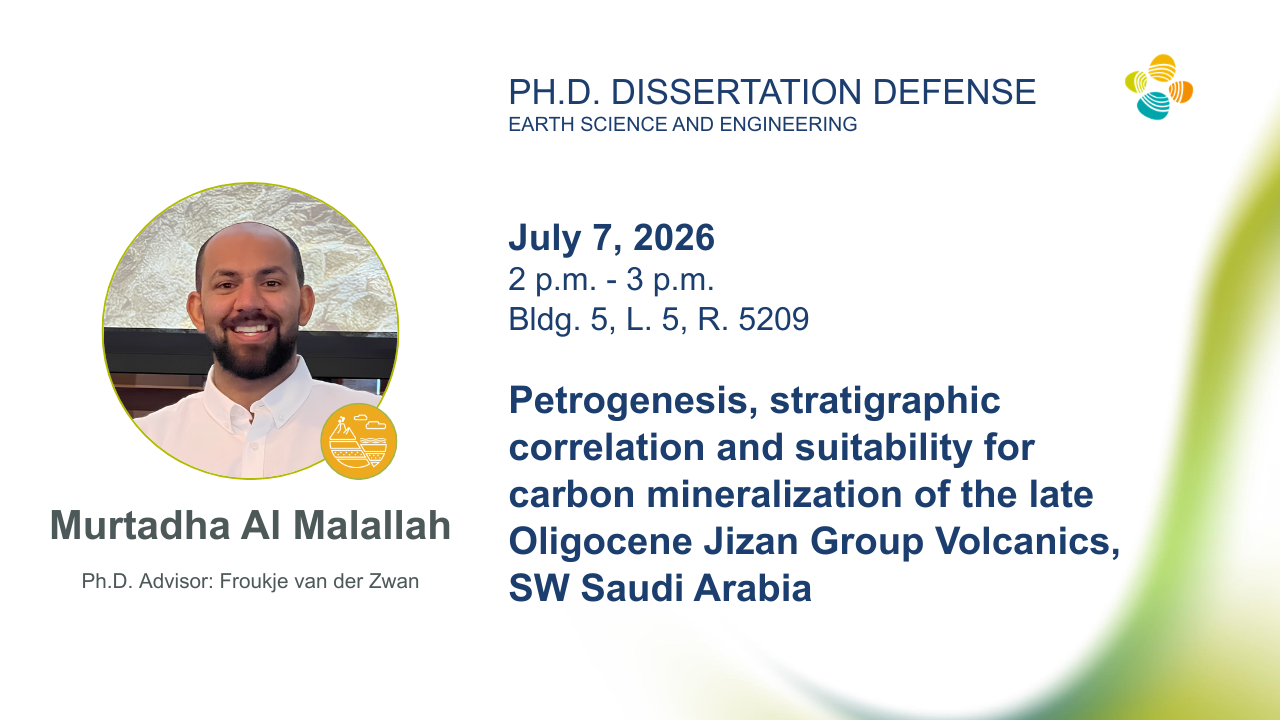
Petrogenesis, Stratigraphic Correlation and Suitability for Carbon Mineralization of the Late Oligocene Jizan Group Volcanics, SW Saudi Arabia
Abstract
The Jizan Group of southwestern Saudi Arabia is one of the best-exposed records of early syn-rift continental volcanism along the southern Red Sea margin, yet it has long been known only at reconnaissance scale, leaving its internal stratigraphy, petrogenesis, and economic potential poorly resolved. This dissertation integrates field mapping, whole-rock and mineral geochemistry, and reactive-transport modelling across the same set of exposures to build, in turn, a stratigraphic framework, a petrogenetic and geodynamic interpretation, and an assessment of the Group as a target for carbon mineralization.
Combined field and geochemical mapping shows that the Jizan Group is markedly more heterogeneous than its reconnaissance-scale subdivision implies. Four geochemical groups (GG1–GG4), resolved by principal component analysis of trace-element data and anchored in time by the lacustrine Baid Formation, are organized into three successive magmatic phases between ~30 and ~21 Ma: a thick tholeiitic basal phase (GG1), a coeval bimodal phase split laterally into a southern and a northern domain (GG2 and GG3), and a younger, more alkaline phase (GG4). A revised, geochemically defined stratigraphy is proposed to replace the lithology-based scheme, and the dike record is reinterpreted as a marker of stress history and relative timing rather than an additional magmatic phase.
Petrogenetic analysis of the same succession shows that the magmas evolved dominantly by fractional crystallization with limited crustal contamination, and that the depth of melting migrated upward through the garnet–spinel transition with time, recording progressive lithospheric thinning. A consistently weak plume signature, an order of magnitude below the Yemen Traps and core Afar basalts, indicates that the volcanism was fed by decompression melting of an Afar-flavored but thermally unremarkable asthenosphere. The data therefore favor a predominantly passive, mechanically driven origin for early rifting at this margin, extending the contamination-and-underplating model established for the coeval Tihama Asir Magmatic Complex into the extrusive record.
Finally, PHREEQC reactive flow-path modelling of representative samples shows that lithology and alteration are the first-order controls on carbon-mineralization potential. Fresh mafic rocks (basalt and gabbro) remove 85–100% of injected carbon within a few years, whereas felsic and volcaniclastic units and strongly altered basalt are effectively unreactive. Because basaltic reactivity is governed by mineral assemblage rather than bulk chemistry, target selection must weigh reactivity together with unit thickness and alteration state; on this basis the thick, fresh, basalt-dominated intervals of Group 1 in the south and Group 3 in the north are identified as the most favorable injection targets. Together, the three studies demonstrate that a single, geochemically resolved stratigraphy underpins both the tectonic interpretation of the southern Red Sea margin and the practical evaluation of the Jizan Group for CO₂ storage.
-jpg.jpg?sfvrsn=53dccb43_2)