Jun 2026
A Multi-Criteria Framework for Circular Carbon Pathways: Integrating Life-Cycle Sustainability, Techno-Economics, and System Optimization
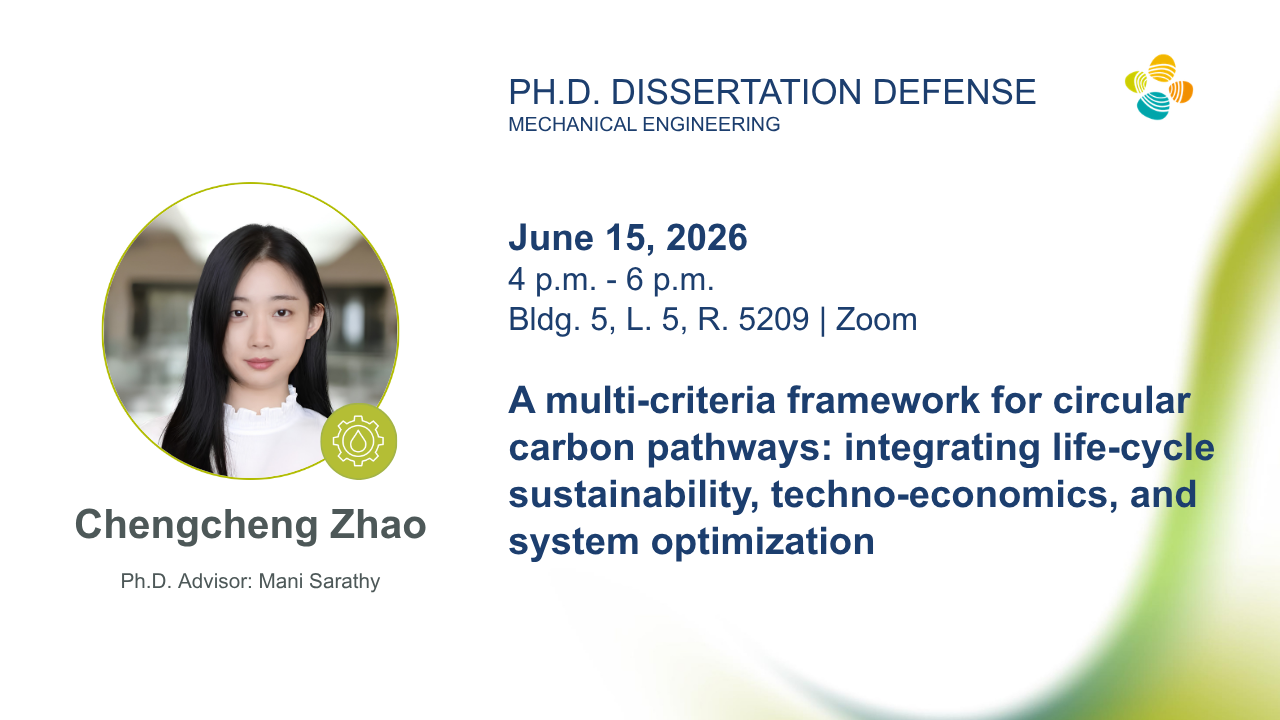
Zoom: https://kaust.zoom.us/j/98437046232
Committee :
- Advisor: Prof. S. Mani Sarathy
- Chair: Prof. Sami Al-Ghamdi
- External examiner: Prof. Guiyan Zang
- ME examiner: Prof. Aamir Farooq
Abstract
The Paris Agreement sets the objective of limiting the increase in global average temperature to well below 2 °C above pre-industrial levels, while pursuing efforts to restrict the increase to 1.5 °C. Achieving these targets requires deep decarbonization across all major emitting sectors, among which transport remains particularly challenging because of its continued reliance on fossil fuels and its substantial contribution to global greenhouse gas emissions. Carbon neutrality in the transport sector therefore depends not only on advances in vehicle and propulsion technologies, but also on the deployment of low-carbon energy carriers, including hydrogen, electricity, and sustainably produced liquid and gaseous carbon-based fuels.
This work develops a comprehensive framework integrating life-cycle assessment (LCA), techno-economic analysis (TEA), and optimization to evaluate circular low-carbon pathways in transport and energy systems, with particular emphasis on Saudi Arabia and broader global applications. It is structured around four interconnected themes: (i) decarbonization options for urban bus transport in Saudi Arabia; (ii) a global environmental assessment of passenger vehicle energy carriers and powertrain technologies; (iii) life-cycle and techno-economic performance of power-to-fuel systems including e-methanol, methanol-to-gasoline, methanol-to-jet, and Fischer–Tropsch fuels across alternative electrolyzer technologies and CO2 supply options; and (iv) a mixed-integer linear programming framework for optimizing global e-SAF pathways under renewable variability and policy constraints such as ReFuelEU Aviation and CORSIA.
The findings show that no single decarbonization pathway is universally optimal — the preferred strategy depends on local energy mix, infrastructure, resource endowments, and policy context. Taken together, this work provides policy-relevant evidence to support Saudi Arabia's Vision 2030 energy transition and offers methodological advances of broader relevance to global decarbonization efforts.
Biography
Chengcheng Zhao is a PhD candidate in Mechanical Engineering at KAUST, working with Prof. S. Mani Sarathy on the sustainability of low-carbon energy systems. Her research integrates life cycle assessment, techno-economic analysis, and mathematical optimization to evaluate renewable hydrogen, CO2-derived e-fuels, and sustainable aviation fuels — with applied case studies across road, air, and urban transport in Saudi Arabia. Her work on hydrogen fuel-cell buses helped inform Saudi Arabia's deployment of hydrogen buses in Mecca. She has been a visiting researcher at ETH Zurich (Prof. André Bardow) and Imperial College London (Prof. Benoit Chachuat), and previously worked as a student assistant at Jülich Research Centre (IEK-14), part of the Helmholtz Association, where she studied alternative aviation fuels for urban emission reduction. She holds an M.Sc. in Sustainable Energy Supply from RWTH Aachen and is a recipient of the KAUST PSE Dean's Award.