04
Jun 2026
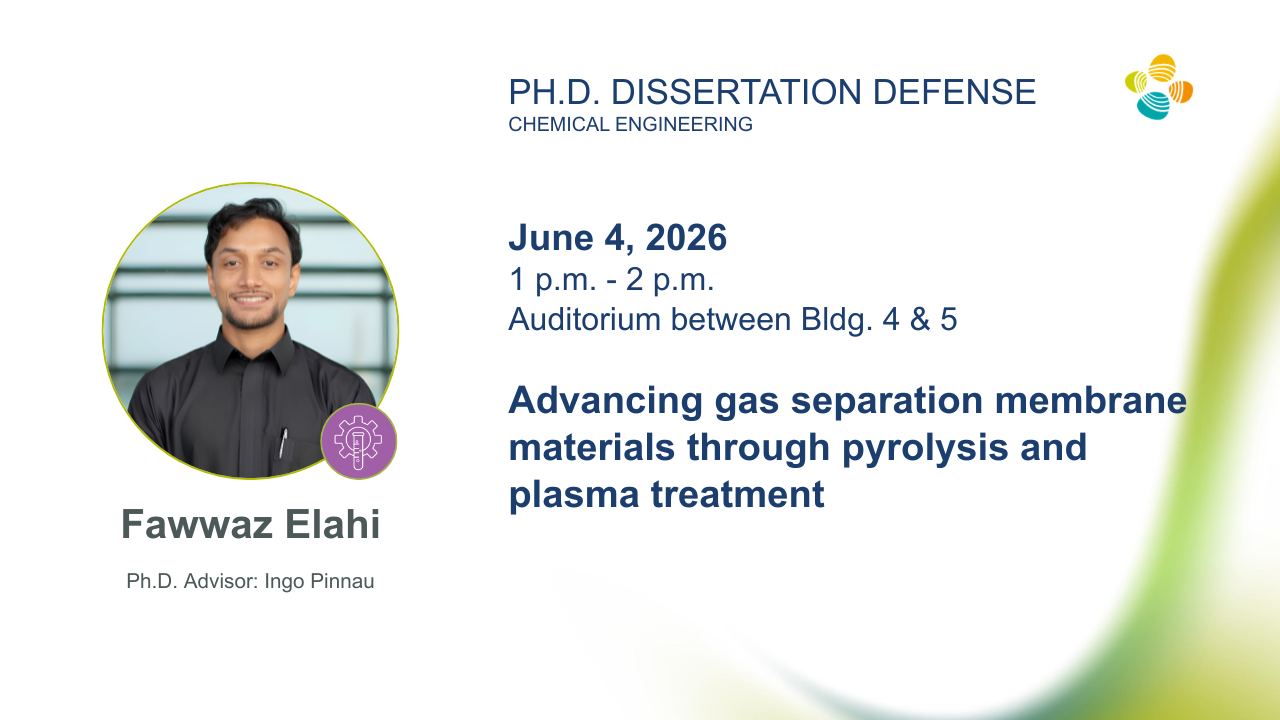
PhD Dissertation
Advancing Gas Separation Membrane Materials through Pyrolysis and Plasma Treatment
Committee Members Information
- Ph.D. Advisor: Professor Ingo Pinnau (KAUST, Chemical Engineering)
- External Examiner: Professor William Koros, Professor, Roberto C. Goizueta Chair for Excellence in Chemical Engineering, Georgia Institute of Technology
- Committee Chair: Professor Mohammad Eddaoudi (KAUST, Chemistry)
- 4th Committee Member: Professor Javier Ruiz Martinez (KAUST, Chemical Engineering)
- 5th Committee Member: Professor Carlos Grande (KAUST, Chemical Engineering)
Abstract
The increasing global demand for energy, coupled with the environmental and economic burden associated with conventional separation processes, has intensified the need for more efficient alternatives to thermally driven technologies. Among these, membrane-based gas separation has emerged as a promising approach due to its low energy requirements, low carbon-footprint and ability to exploit molecular-level transport mechanisms. However, current membrane materials are still constrained by the permeability–selectivity trade-off, long-term stability issues, and limited performance in highly challenging separations such as olefin/paraffin systems and hydrogen recovery.
This dissertation addresses these challenges through two distinct material development strategies: (i) the design and optimization of carbon molecular sieve (CMS) membranes for olefin/paraffin separations, and (ii) the plasma modification of polymeric membranes, with particular emphasis on argon plasma treatment, to enhance gas separation performance. CMS membranes derived from advanced polymer precursors were investigated for ethylene/ethane and propylene/propane separations. Building upon recent developments in triptycene-based polymers, new derivatives were synthesized and evaluated to improve permeability while maintaining exceptional selectivity. It was found that fluorinated derivatives led to pore opening and reduced molecular sieving ability, whereas the non-functionalized BTrip-TB precursor achieved optimal performance at lower pyrolysis temperatures (~800 °C), with C2H4 permeability of 2.4 Barrer and C2H4/C2H6 selectivity of 71 under mixed-gas conditions. Additionally, a systematic study on 6FDA-based polyimides revealed that dual crosslinking mechanisms that originate from both the dianhydride and diamine functionalities can enhance CMS performance. Pre-crosslinking at 450 °C followed by pyrolysis at 800 °C produced improved propylene/propane mixed-gas performance, particularly for functionalized polymers such as 6FDA-OH, highlighting the importance of incorporating reactive moieties for effective structural tuning.
In the second part, argon plasma treatment was applied to a wide range of polymeric membranes spanning low to high fractional free volume. The results demonstrated that plasma treatment induces significant changes in gas transport behavior, primarily through surface modification and possible crosslinking. Dense polymers such as polysulfone and Matrimid exhibited substantial increases in selectivity with moderate permeability loss, whereas high free-volume polymers showed more pronounced reductions in permeability accompanied by large selectivity enhancements, especially for H2 related application. These findings suggest that argon plasma treatment can serve as a versatile post-modification strategy for tuning membrane performance without altering bulk material properties.
Overall, this dissertation provides new insights into the structure–property relationships governing both CMS formation and plasma-modified polymeric membranes. It demonstrates that careful control of precursor chemistry, thermal history, and surface treatment conditions can significantly improve membrane performance for some of the most challenging industrial gas separations. These findings contribute to the broader effort of developing next-generation membrane materials capable of reducing the energy intensity of large-scale separation processes.