May 2026
Electrolyte Design for Practical Li–S Batteries
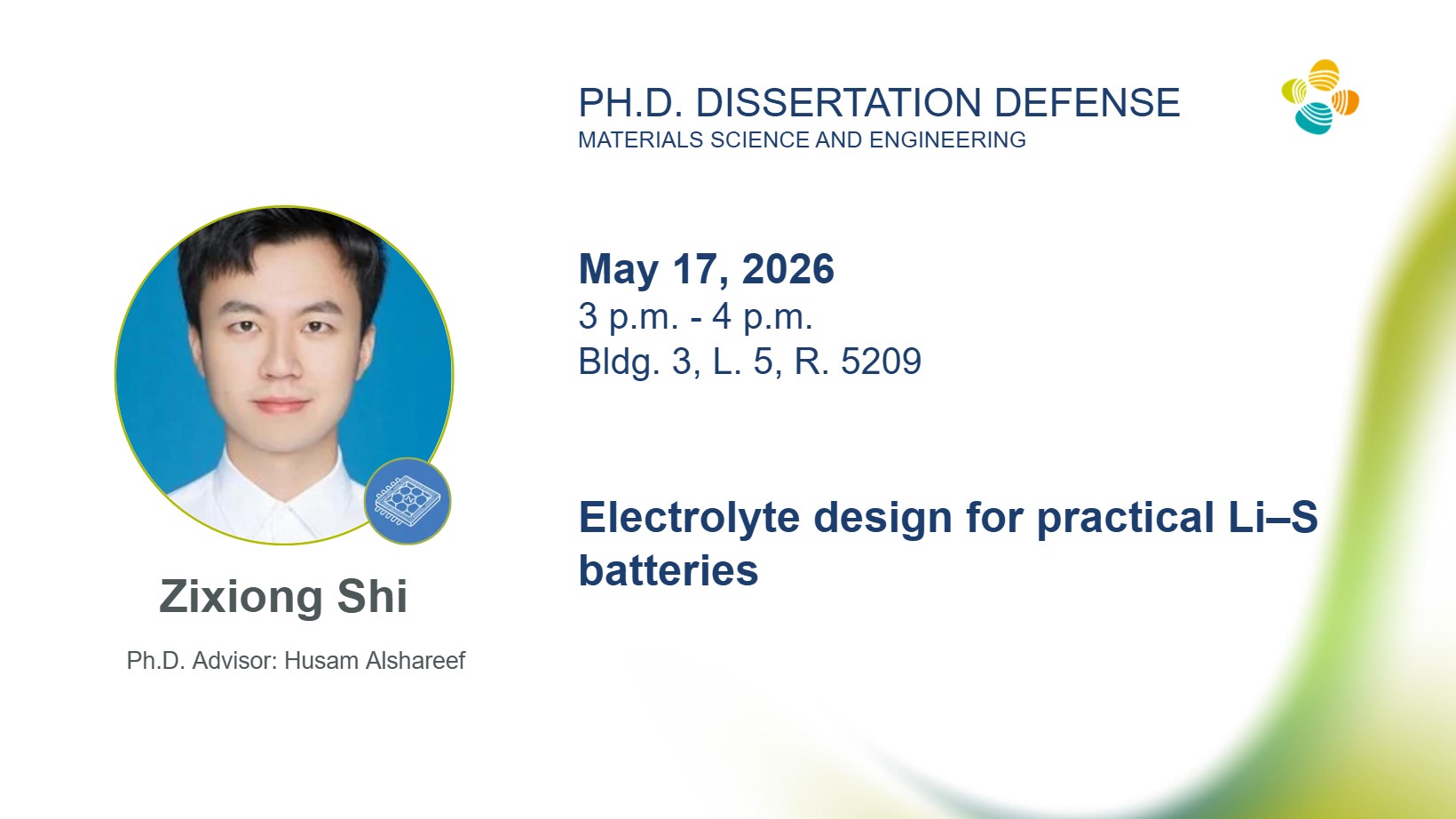
Ph.D. Defense Committee Members
- Academic Advisor: Prof. Husam Alshareef
- Committee Chair: Prof. Pedro Castano
- External Examiner: Prof. Jia Xie
- Committee Member: Prof: Omar Mohammed
Abstract:
Li–S batteries showcase an ultrahigh theoretical energy density of 2600 Wh kg–1, making it a desirable candidate for next-generation energy storage system. Nevertheless, its commercialization is impeded by a multitude of challenges, which are highly associated with the current electrolyte system. For one thing, high electrolyte usage is needed to enable sufficient dissolution of polysulfides, thus lowering the actual energy density of Li–S batteries. For another, the electrochemical performance of Li–S batteries will deteriorate rapidly at high temperatures because of aggravated polysulfide shuttling and electrolyte consumption. Therefore, the thesis objective is to design novel electrolytes for achieving the practical application of Li–S batteries.
This work is subdivided into three main parts.
In the first section, we focus on designing electrolytes to reduce the dependence on electrolyte usage, with an emphasis on studying the electrolyte microstructure, polysulfide speciation, and redox kinetics. Furthermore, the crucial significance of as-proposed electrolyte systems on elevating the electrochemical performance of Li–S batteries under lean-electrolyte working conditions will be highlighted.
In the second section, we focus on elucidating the temperature-dependent evolution of electrolyte structure, polysulfide speciation, and interfacial chemistry. Furthermore, universal electrolyte design principle will be established for constructing safe and longevous high-temperature Li–S batteries. The failure mechanism of Li–S batteries in current electrolytes will be studied.
In the last section, we focus on developing nuclear magnetic resonance (NMR) test technologies to study and design electrolytes, which aims to open a new avenue for designing better electrolytes for emerging battery technologies. Principes, methods, and analysis of NMR spectroscopy will be subject to a comprehensive discussion, thus offering a guidance to understand complex solvation structure, ion dynamics, and chemical interaction of liquid electrolytes.