May 2026
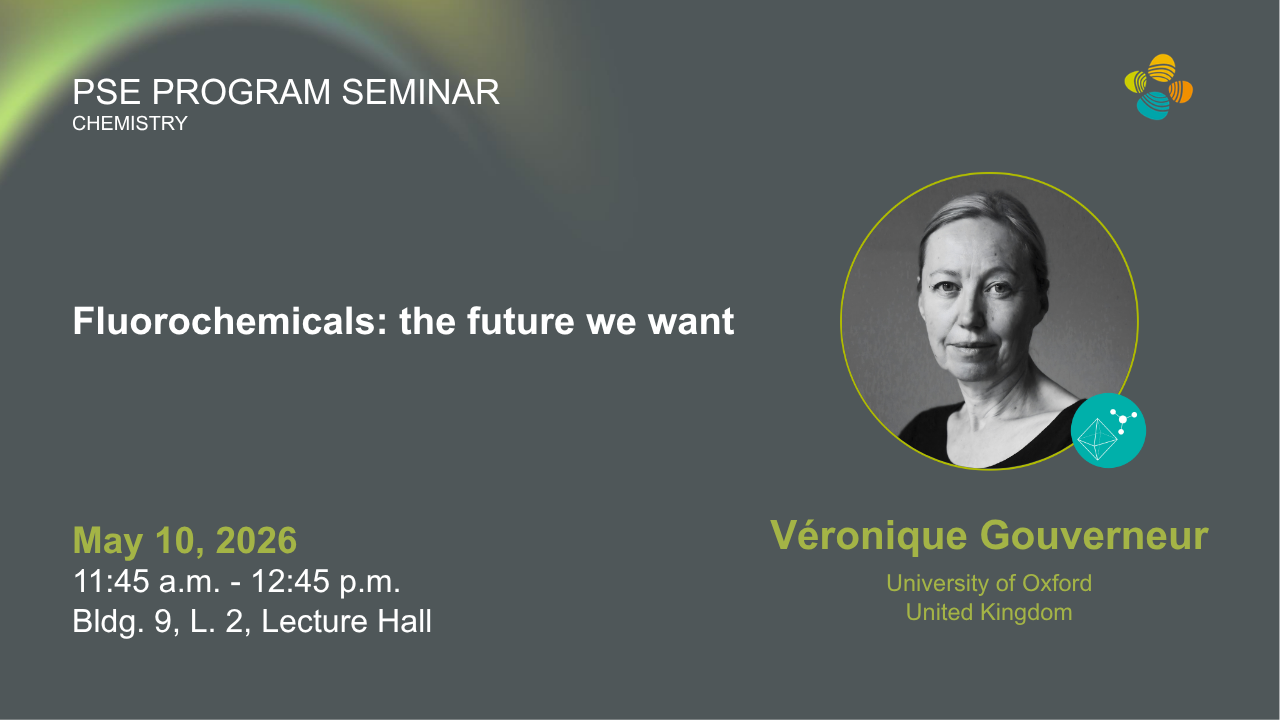
Fluorochemicals: The Future We Want
Abstract
Fluorochemicals quietly power our modern lives serving as medicines, agrochemicals and strategic materials including refrigerants, batteries and electronics. All fluorochemicals are prepared from — the now critical — mineral Fluorspar (CaF2). The first step of any synthesis is the conversion of Fluorspar to hydrogen fluoride (HF) upon treatment with H2SO4 at 300 °C, a process reported by Scheele in 1771. Highly toxic HF has caused serious accidents, some with fatal casualties and severe damage to the environment. The fluorochemical industry is today exposed to supply shortages, safety constraints and environmental damage. Our goal is to reinvent fluorine chemistry from the ground up with innovative, safe and economically viable Fluorspar technologies that bypass HF, and with processes to recover the fluorine content of waste fluorochemicals such as PFAS for a circular fluorine economy. Such ground breaking development could support the fluorine sector, protect workers, simplify supply chains, and reduce the energetic and environmental burden of fluorochemical production. This lecture will discuss our results to date, and our approach to bridge the gap between academic discoveries and societal impact.
Biography
Véronique Gouverneur obtained a PhD in chemistry at the Université Catholique de Louvain (LLN, Belgium) under the supervision of Professor Léon Ghosez. In 1992, she moved to a postdoctoral position with Professor Richard A. Lerner at the Scripps Research Institute (California, USA). She accepted a position of Maître de Conférence at the University Louis Pasteur in Strasbourg (France); during this period, she worked with Dr Charles Mioskowski and was Associate Member of the “Institut de Science et d'Ingénierie Supramoléculaires” led by Professor Jean-Marie Lehn.
Véronique started her independent research career at the University of Oxford in 1998 in the the Department of Chemistry and was promoted to Professor of Chemistry in 2008. From 1998 to 2022, she was the holder of a tutorial fellowship at Merton College, Oxford where she taught organic chemistry. In 2022, she became the Waynflete Professor of Chemistry.
Her research aims at developing new approaches to address long-standing problems in the synthesis of fluorinated molecules including pharmaceutical drugs and probes for molecular imaging (Positron Emission Tomography). To date, she has mentored and supervised the research projects of >180 students (DPhil, MSc, PDRA). She has coordinated European ITN projects and received funding from numerous bodies, such as UKRI, ERC (ERC Advanced Grants 2019–2024 and 2024–2028) and EPSRC. She is the (co)author of >250 peer-reviewed publications and >15 patents.
Her research has been disseminated at numerous conferences and rewarded by multiple prizes and distinctions, including the 2015 ACS Award for Creative work in Fluorine Chemistry, the 2016 RSC Tilden Prize, the 2016 Tetrahedron Chair, the 2019 RSC Organic Stereochemistry Award, the 2019 Prelog Medal, the 2021 Henri Moissan Prize, the 2022 Arthur C. Cope Award, the 2022 EuChemS Female Organic Chemist of the Year Award, the 2024 Prous Institute - Overton and Meyer Award for New Technologies in Drug Discovery and the 2024 Davy Medal.
Véronique has also been elected Member of the European Academy of Sciences (EURASC) in 2017, Fellow of the Royal Society in 2019, International Honorary Member of the American Academy of Arts and Sciences in 2022 and Member of the US National Academy of Sciences (NAS) in 2025.