May 2026
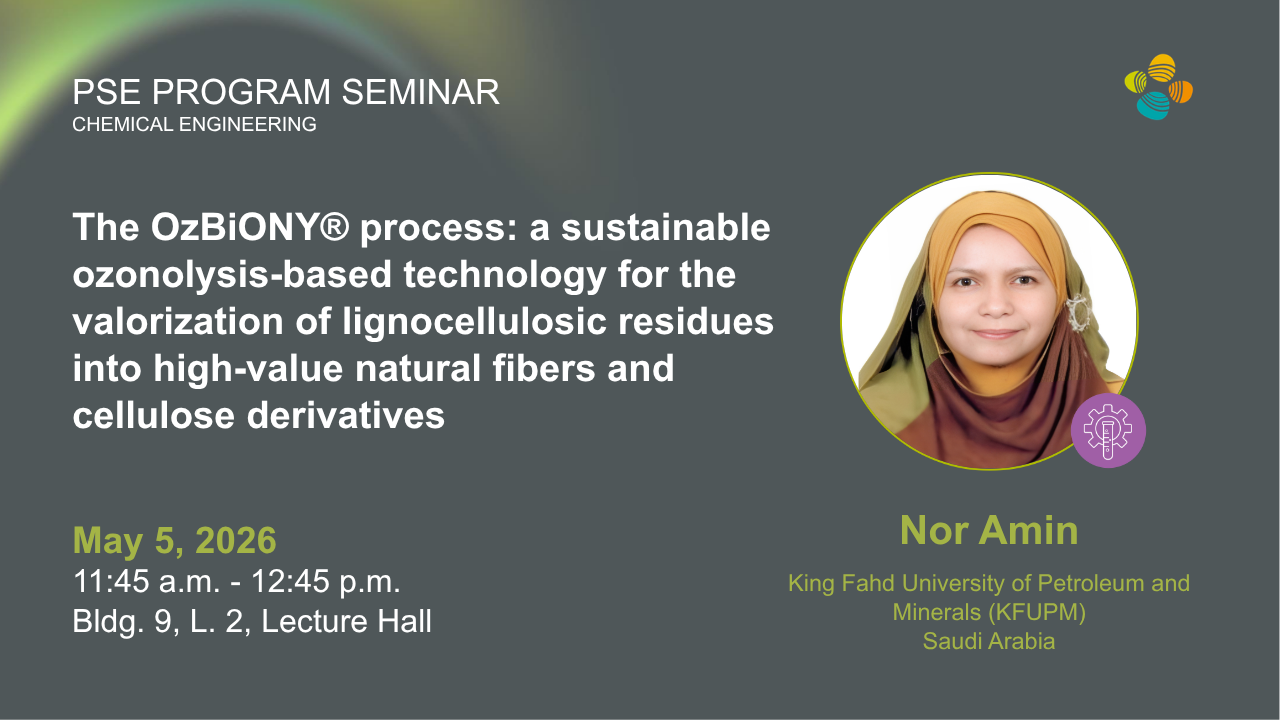
The OzBiONY® Process: A Sustainable Ozonolysis-Based Technology for the Valorization of Lignocellulosic Residues into High-Value Natural Fibers and Cellulose Derivatives
Abstract
The global transition toward a circular bioeconomy necessitates the development of advanced technologies capable of converting massive streams of agricultural and forestry residues into high-value industrial precursors. Lignocellulosic biomass, while abundant, remains underutilized due to its recalcitrant structure, which typically requires energy-intensive and chemically aggressive pre-treatment methods like Kraft pulping or acid hydrolysis. These traditional pathways often result in significant environmental degradation and high operational costs. This seminar introduces the OzBiONY® process, a transformative, environmentally mild ozonolysis-based technology designed to bypass these limitations and facilitate the sustainable production of high-purity cellulose and natural fibers.
Using Oil Palm Empty Fruit Bunch (EFB) as a model for global lignocellulosic waste, this study details a sequential treatment involving ozonation (O3), mild alkaline extraction (Ex), and re-ozonation O3). The process demonstrates a robust capacity for delignification, significantly enriching the cellulose content (up to 79%) while operating at ambient temperatures and low pressures. Advanced characterization results, including SEM, NMR, and FTIR analysis, reveal that the OzBiONY® process successfully individualizes fiber bundles into high-quality natural fibers (260 µm length) and introduces carboxy-group functionalities (37 mmol/g) essential for downstream chemical modification.
Furthermore, a comprehensive Techno-Economic Assessment (TEA) underscores the global scalability of this technology. With an Internal Rate of Return (IRR) of 35% and a competitive production cost (USD $951/tonne), the OzBiONY® process offers a commercially viable alternative to fossil-derived materials. By transforming heterogeneous waste into versatile derivatives—such as microcrystalline cellulose (BiOzMCC), carboxymethyl cellulose (BiOzCMC), and nanocellulose (BiOzCNC)—this technology provides a scalable blueprint for the global biomass industry to meet ESG goals, reduce net carbon emissions, and foster a truly circular economy.
Keywords: Global Biomass Valorization, Ozonolysis, Lignocellulose, Natural Fibers, Circular Economy, Sustainable Manufacturing.
Biography
Professor Ir. Dr. Nor Aishah Saidina Amin
Professor, Department of Chemical Engineering, King Fahd University of Petroleum and Minerals (KFUPM), Saudi Arabia
Professor Nor Amin is an eminent scholar in biofuels, CO₂ reduction, photo- and plasma-catalysis, and chemical reaction engineering. Over her career, she has published five books, eight book chapters, and more than 250 Web of Science–indexed journal articles, earning international recognition as a Highly Cited Researcher (Clarivate Analytics).
She is a Professional Engineer (PEng) and Fellow of the Institution of Chemical Engineers (FIChemE), as well as a Fellow of the Academy of Sciences Malaysia (ASM). Her exceptional research contributions have been honored with numerous prestigious awards, including:
- Malaysia Research Star Award
- Top Research Scientist Malaysia (TRSM)
- Leaders in Innovation Fellowship Award, Royal Academy of Engineering (UK)
- MIT-UTM Sustainable City Fellowship
- Fulbright Fellowship University of Kentucky, USA
- MINDS Outstanding Woman Scientist Lifetime Scientific Research Achievement Award
- Malaysia Scopus Research Excellence Award (Groundbreaking Contributions category)
Professor Nor is also an influential editor in her field. She currently serves as Subject Editor for Reaction Engineering in Chemical Engineering Research and Design, and has held editorial appointments with Energy Conversion and Management, Sustainable Chemistry for Climate Action, and Energy & Fuels.
She earned her B.Sc. from California State University, Long Beach, her M.Sc. from the University of Manchester Institute of Science and Technology (UK), and her Ph.D. in from the Illinois Institute of Technology, Chicago (1996) all in Chemical Engineering.
Before joining KFUPM, she was a Professor at the Faculty of Chemical and Energy Engineering, Universiti Teknologi Malaysia (UTM), where she served until August 2025.