May 2026
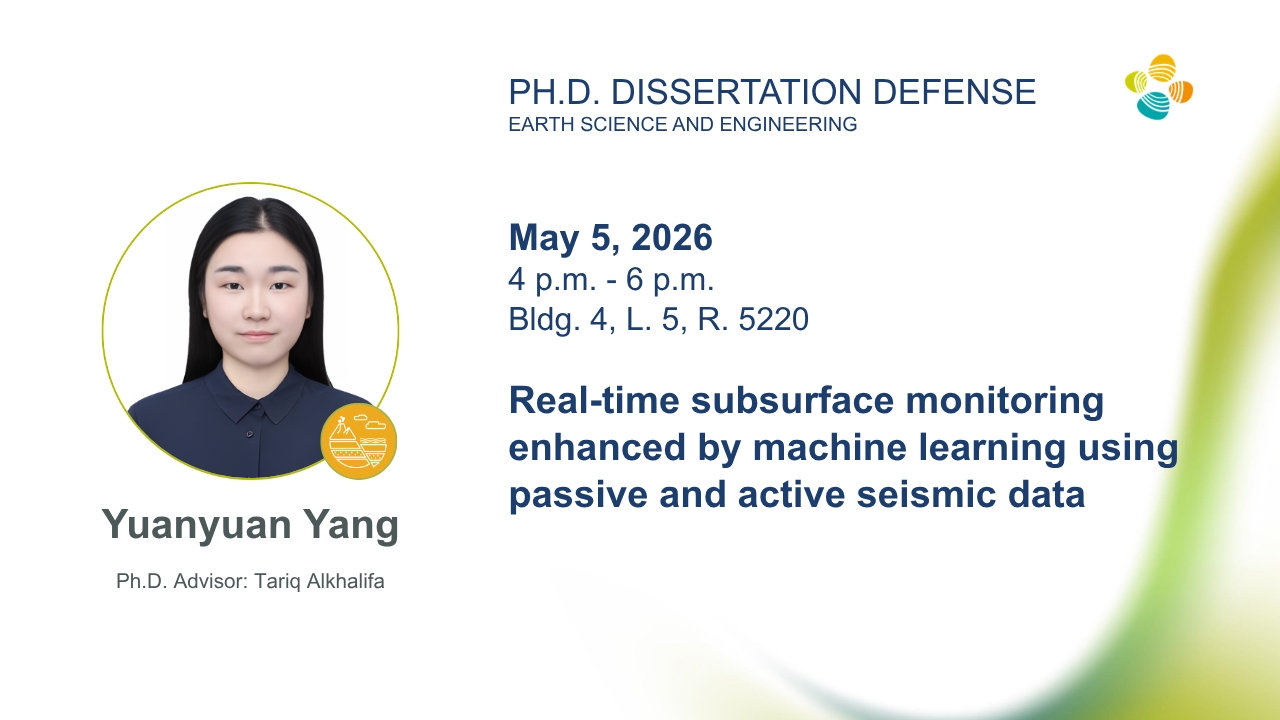
Real-Time Subsurface Monitoring Enhanced by Machine Learning Using Passive and Active Seismic Data
Committee Members Information
Abstract
Real-time subsurface monitoring is essential for understanding dynamic geological processes associated with energy exploration, resource exploitation, and sustainability efforts, such as geological carbon sequestration, geothermal energy production, and mining integrity management. Microseismic monitoring and active seismic imaging provide critical information about subsurface deformation, fracture evolution, and fluid migration. However, conventional seismic processing workflows for microseismic event detection and characterization, imaging, and model updating are often computationally expensive and rely on expert efforts to handle field complications, hindering their applicability for continuous real-time monitoring. Machine learning has emerged as a powerful tool to address these challenges by enabling fast, data-driven inference directly from seismic observations. This dissertation focuses on developing machine learning-enhanced frameworks for real-time subsurface monitoring using both passive and active seismic data. The research begins with a unified deep learning approach that jointly performs microseismic event detection and source location directly from raw waveform recordings using transformer-based architectures. To further improve 3D localization accuracy in complex geological settings based on elastic media assumption, an extension is developed to integrate surface and borehole seismic measurements through multi-branch feature extraction and data fusion. Recognizing the need for detection-free acceleration, latent diffusion models are introduced as a data-adaptive imaging condition to generate probabilistic microseismic source location maps from time-reversal wavefield representations. Beyond passive monitoring, this dissertation also develops a physics-based cross-well seismic imaging methodology for tracking CO2 plume evolution, by employing the energy-norm imaging condition and pseudo-Hessian compensation to enhance time-lapse imaging resolution and reliability. Finally, a joint inversion strategy based on neural operators is proposed to simultaneously update microseismic source locations and subsurface velocity models, enabling more efficient subsurface characterization.Together, these contributions demonstrate how advanced machine learning algorithms can be systematically embedded within seismic monitoring workflows to achieve accurate, efficient, and environment-adaptive subsurface monitoring, providing practical tools for applications across energy, resource, and sustainability initiatives.