Apr 2026
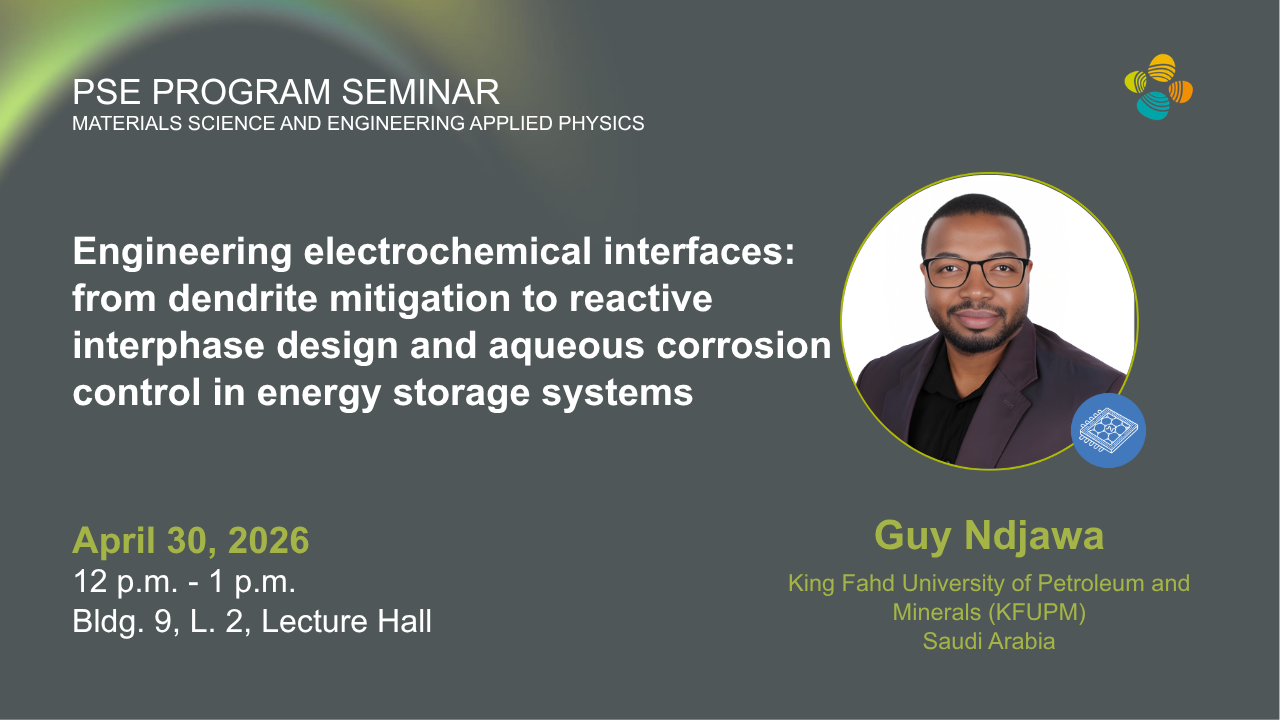
Engineering Electrochemical Interfaces: From Dendrite Mitigation to Reactive Interphase Design and Aqueous Corrosion Control in Energy Storage Systems
Abstract
All-solid-state and aqueous batteries offer compelling alternatives to lithium-ion technology, but both are currently held back by unstable electrochemical interfaces. This talk presents control and materials design approaches to engineering these interfaces across different battery platforms. In solid-state cells, uncontrolled lithium dendrite growth originates from coupled electrochemical and morphological instabilities at the anode interface. We approach this using a phase-field framework to design control algorithms that may serve as a scaffold for machine learning-based control protocols. Suppressing dendrites, however, does not resolve the intrinsic reactivity of the lithium–solid electrolyte interface. We present a computational screening framework that leverages solid-state chemistry to design more stable interfaces through mitigation of the reducing power of lithium anodes. Finally, we discuss how electrolyte design can serve as an effective strategy for addressing analogous challenges in aqueous systems, including aluminum and zinc-air batteries.
Biography
Dr. Guy Olivier Ngongang Ndjawa is Assistant Professor of Chemical Engineering at KFUPM, where he works at the intersection of materials science, electrochemistry, and sustainable energy. He received his Ph.D. in Materials Science and Engineering from KAUST and completed postdoctoral research at Princeton University. His group’s work centers on energy-storage materials, especially solid-state and aqueous batteries, with a focus on interfacial stability, computational modeling, and the design of next-generation materials for clean energy technologies.