Apr 2026
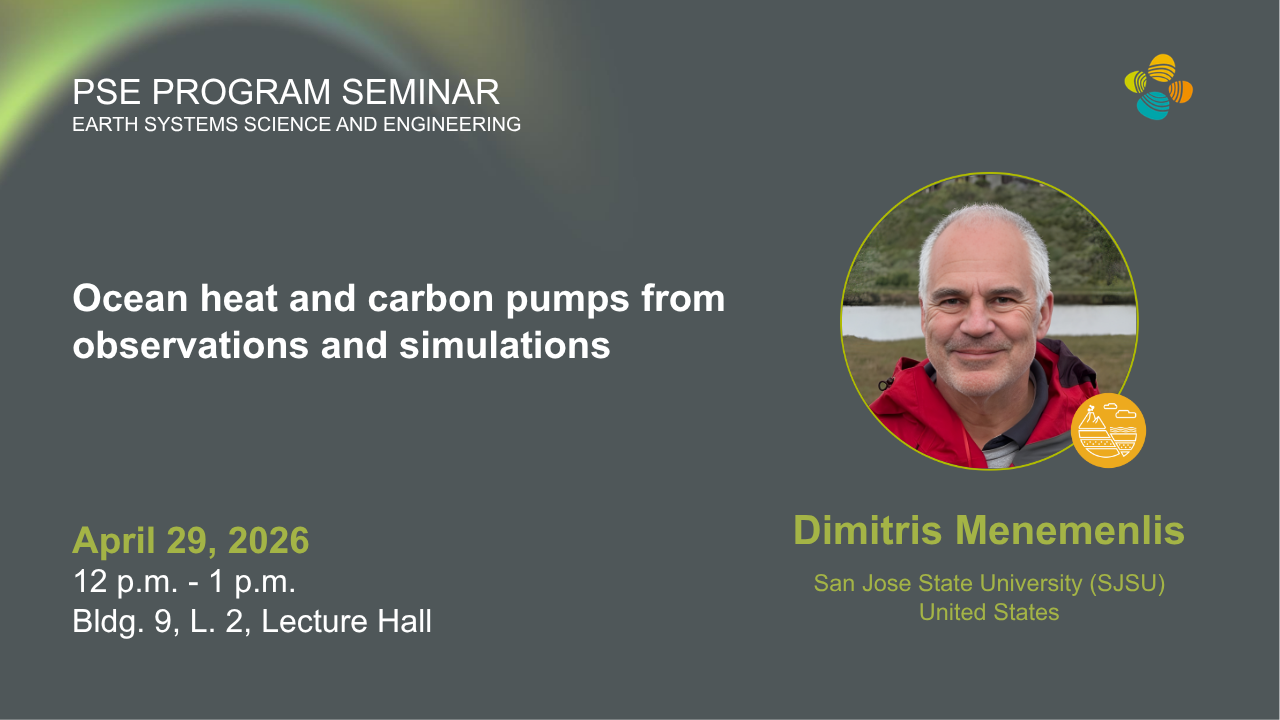
Ocean heat and carbon pumps from observations and simulations
Abstract
The ocean is the climate's largest reservoir of freshwater, carbon, and heat. The ocean contains ~97% of the Earth's total water and ~95% of the carbon in the planet's active carbon cycle. Since the dawn of the industrial era, the ocean has absorbed ~90% of the excess heat trapped by greenhouse gases. In order to understand the impact of these vast reservoirs on present-day climate, the extent to which climate is changing, the places in which heat and nutrients are being moved, the uptake of carbon from the atmosphere, and a host of other scientific questions, we need systematic
syntheses of the diverse and sparse available observations with our best understanding of the principles determining ocean circulation, chemistry, and ecology. Almost half a century ago, ocean scientists envisioned such a global-ocean model-data synthesis, an ambitious, ongoing, multi-generational effort. I will discuss two components of this ongoing work, which are being carried out as part of the Estimating the Circulation and Climate of the Ocean (ECCO) project. In the first part of this talk, I will describe the development of a world-class, data-constrained, global-ocean physics and biogeochemistry model, which is contributing to our understanding of the ocean heat and carbon pumps. In the second part of this talk, I will describe the development of submesoscale-admitting, global-ocean simulations, which are being used to study the role of submesoscale processes on the uptake and storage of heat and carbon by the ocean.
Biography
Dr. Dimitris Menemenlis obtained a PhD in acoustical oceanography from the University of Victoria under the supervision of Dr. David Farmer and he carried out his Postdoctoral studies at the Massachusetts Institute of Technology (MIT) working on the Acoustic Thermometry of Ocean Climate (ATOC) project under the supervision of Prof. Carl Wunsch. Dr. Menemenlis subsequently spent 27 years at the NASA Jet Propulsion Laboratory (JPL). Currently he is a Senior Research Associate at the Moss Landing Marine Laboratories (MLML) of the San Jose State University (SJSU). Dr. Menemenlis is a developer of the MIT general circulation model (MITgcm) and a core contributor to the Estimating the Circulation and Climate of the Ocean (ECCO) project, which provides data syntheses essential for modern climate research. His research spans topics that range from submesoscale ocean dynamics and sea ice to air-sea interactions and the global carbon cycle. He is currently a lead developer of the ECCO-Darwin project, an initiative that integrates global-ocean circulation with biogeochemistry to quantify the drivers of ocean carbon sources and sinks. With a career-long commitment to open-source, data-constrained modeling, his work aims to bridge the gap between theoretical oceanography and satellite observations.