Apr 2026
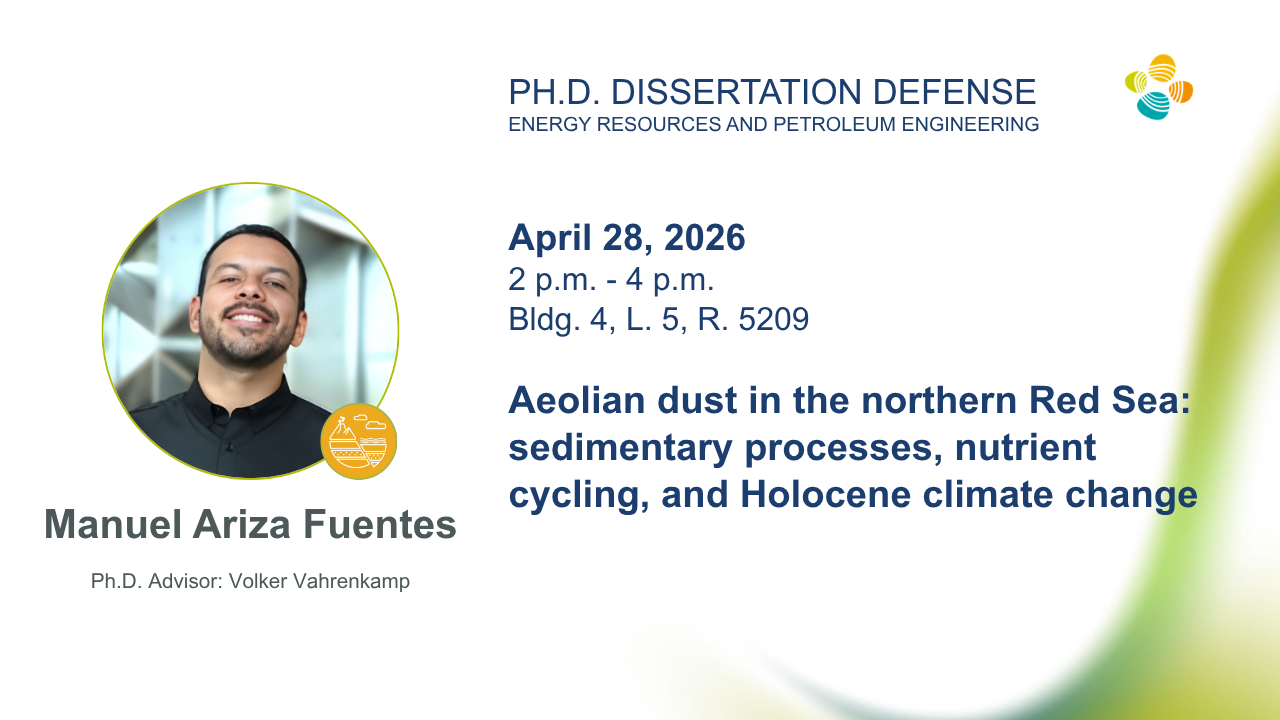
Aeolian Dust in the Northern Red Sea: Sedimentary Processes, Nutrient Cycling, and Holocene Climate Change
Committee Members Information
Abstract
This dissertation investigates the origin, delivery, redistribution, and geochemical transformation of aeolian dust—and to a lesser extent flashflood-derived sediments—sourced from the Saharo-Arabian desert belt and delivered to the Arabian margin of the northern Red Sea, with a focus on the restricted lagoon of the Al Wajh carbonate platform. The study integrates dust mass accumulation rates with mineralogical and grain-size analyses from modern dust traps, lagoonal surface sediments, vibrocores, and deep-sea gravity cores. These datasets are used to (i) quantify and fingerprint terrestrial inputs, (ii) distinguish aeolian material from flashflood-derived siliciclastics, (iii) evaluate how waves, currents, and lagoon circulation redistribute fine sediments prior to burial, (iv) assess evidence for nutrient release from aeolian dust, and (v) reconstruct the Holocene aridity history of the northern Red Sea. By linking modern processes with sedimentary archives, this work advances understanding of how aeolian dust influences nutrient dynamics and sedimentation in oligotrophic carbonate lagoons.