Apr 2026
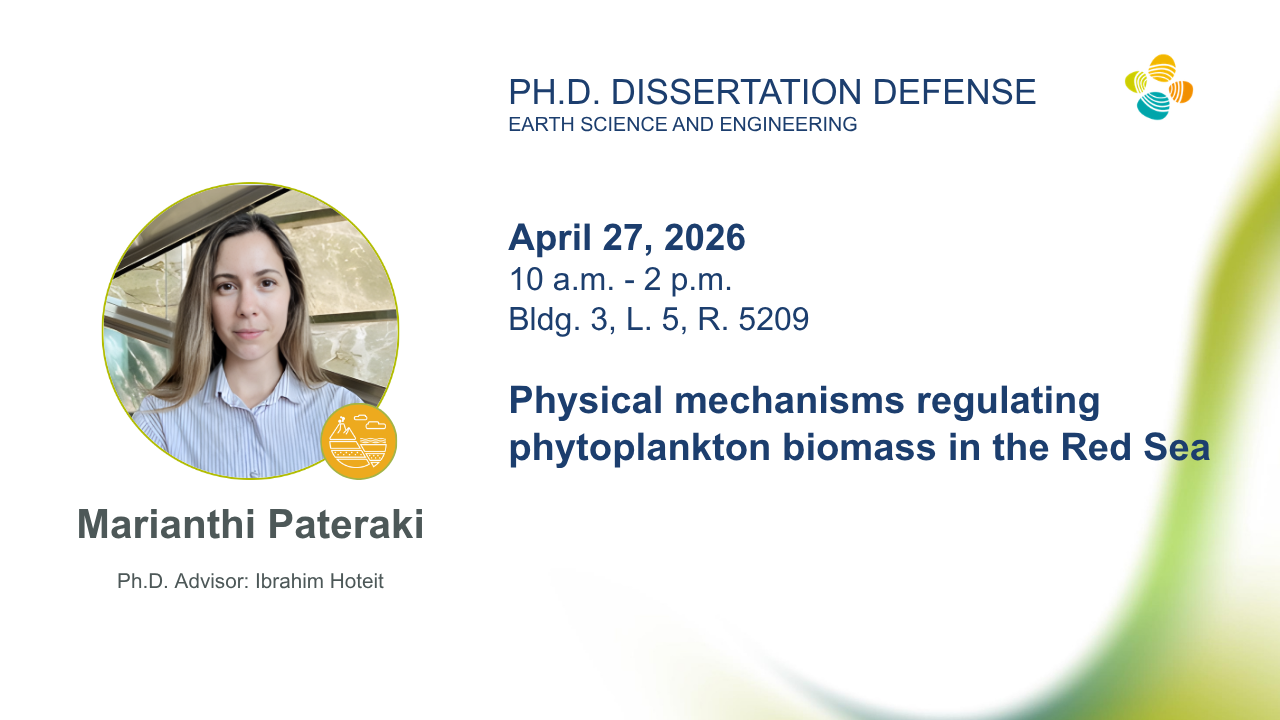
Physical mechanisms regulating phytoplankton biomass in the Red Sea
Committee Members Information
5th Committee Member: Dionysios Raitsos-Exarchopoulos
Abstract
Phytoplankton biomass in oligotrophic tropical seas is primarily constrained by nutrient availability in the surface layer, making physical processes that regulate vertical and lateral nutrient supply a dominant control on primary production. The Red Sea, one of the warmest and most saline marine basins globally, represents an extreme nutrient-limited environment characterized by strong stratification, minimal external nutrient input, and a single oceanic connection to the Indian Ocean through the Bab-el-Mandeb strait. These characteristics render the basin highly sensitive to physical forcing across a wide range of spatial and temporal scales. Understanding how physical mechanisms regulate phytoplankton biomass in this system is therefore essential for interpreting present-day variability and assessing vulnerability to climatic variability and long-term warming. This thesis investigates the physical mechanisms regulating phytoplankton biomass in the Red Sea by integrating long-term, high-resolution regional ocean circulation model simulations with satellite and glider observations. The analysis focuses on the role of vertical mixing, water-mass exchange with the Gulf of Aden, monsoon-driven circulation, and mesoscale to submesoscale dynamics in controlling nutrient supply to the euphotic layer. Basin-wide relationships between mixed-layer depth and satellite-derived surface chlorophyll-a are examined, the seasonal pathways and accessibility of nutrient-rich Gulf of Aden Intermediate Water are quantified, and the modulation of these processes by monsoon variability and Indo-Pacific climate modes is assessed over interannual to decadal timescales. Direct observations are further used to resolve mesoscale and submesoscale vertical motions and their influence on phytoplankton distributions. The results demonstrate that phytoplankton biomass variability in the Red Sea is governed by a hierarchy of physical processes acting across scales. Vertical mixing plays a critical and previously underappreciated role in the southern basin, complementing horizontal nutrient supply from Gulf of Aden waters. The influence of Gulf of Aden Intermediate Water on surface productivity is shown to be spatially and temporally constrained, becoming effective primarily when stratification weakens or mixing intensifies. Monsoon-driven circulation and climate variability modulate these mechanisms in a season-dependent manner, producing contrasting phytoplankton responses. Finally, direct observational evidence reveals that mesoscale and submesoscale vertical motions can intermittently enhance surface biomass and restructure subsurface chlorophyll distributions. Together, these findings provide a unified, process-based framework for understanding phytoplankton regulation in the Red Sea and highlight the basin’s vulnerability to ongoing climate change