Apr 2026
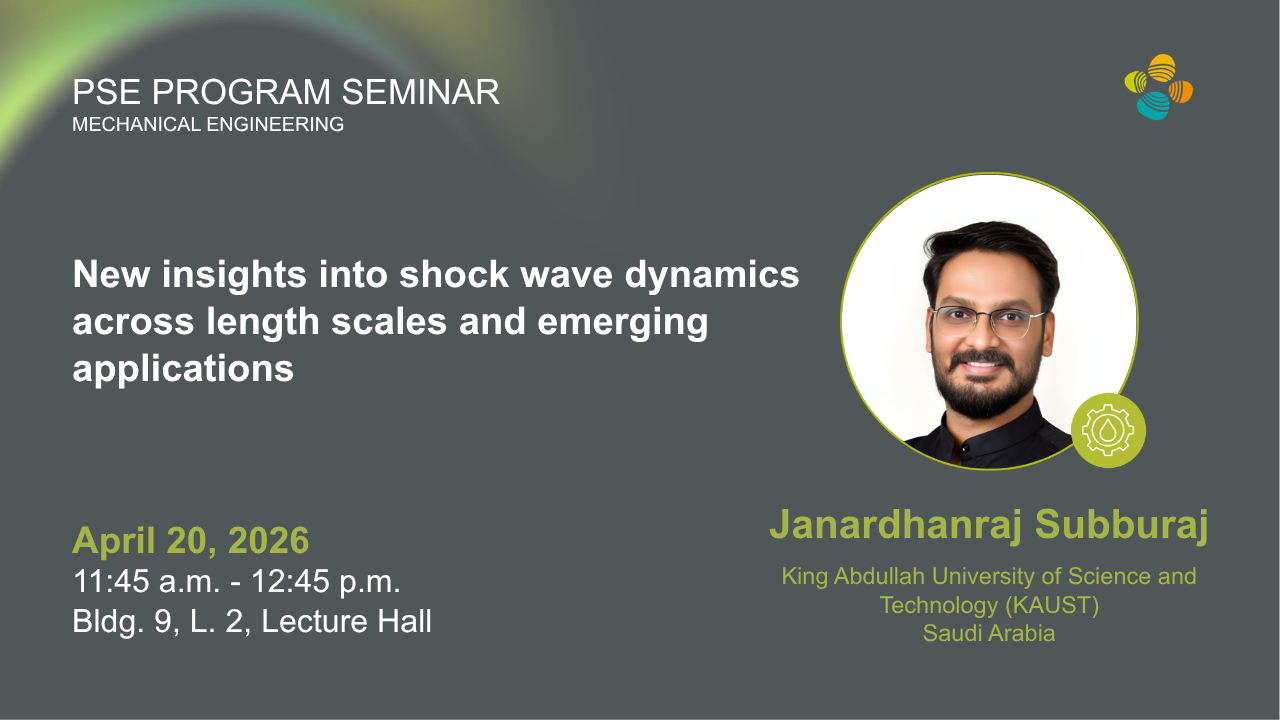
New Insights into Shock Wave Dynamics Across Length Scales and Emerging Applications
Abstract
Shock waves are a fascinating phenomenon observed in nature across a range of length scales, from astrophysical explosions to microscale cavitation bubbles. This talk presents new insights into shock wave dynamics across these scales and illustrates how advances in our fundamental understanding are enabling emerging applications in energy, health, water, and food systems. The first part of the talk introduces the fundamentals of shock wave generation and propagation and traces the evolution of shock tube technology from its origins in the late nineteenth century to the sophisticated multi-mode facilities used today. Particular emphasis is placed on non-ideal effects arising from diaphragm rupture dynamics, shock formation processes, boundary layer growth, and axial flow gradients. These effects, often treated as secondary, can significantly influence the flow conditions produced in laboratory facilities. Investigations across different shock tube operating modes reveal new insights into flow inhomogeneities and their implications for chemical kinetic measurements and high-speed reactive flows. The second part of the talk highlights how shock wave devices can serve as versatile experimental platforms for interdisciplinary research. Examples spanning needle-free drug delivery, water sterilization, material synthesis, and clean energy systems demonstrate how the same underlying shock physics can be harnessed to address challenges across multiple engineering and scientific domains.
Biography
Janardhanraj Subburaj is a Research Scientist at King Abdullah University of Science and Technology (KAUST), where he leads research projects on shock wave dynamics, combustion diagnostics, hydrogen energy systems, sustainable aviation fuels, and technologies for health and environmental applications. He received his Ph.D. and M.Sc. in Aerospace Engineering from the Indian Institute of Science (IISc), Bangalore. His doctoral research focused on supersonic flows in miniature shock tubes and led to several experimental platforms and publications on shock wave dynamics. Prior to joining KAUST, he led industrial R&D programs on shock-wave-assisted oil recovery and related technologies at an IISc-incubated startup company. He is a Senior Member of the American Institute of Aeronautics and Astronautics (AIAA) and a Member of the International Shock Wave Institute (ISWI) and the Royal Aeronautical Society (RAeS).