Apr 2026
Reticular Chemistry and Functional Materials: Design, Synthesis and Application of Metal-Organic Frameworks
Committee Members Information
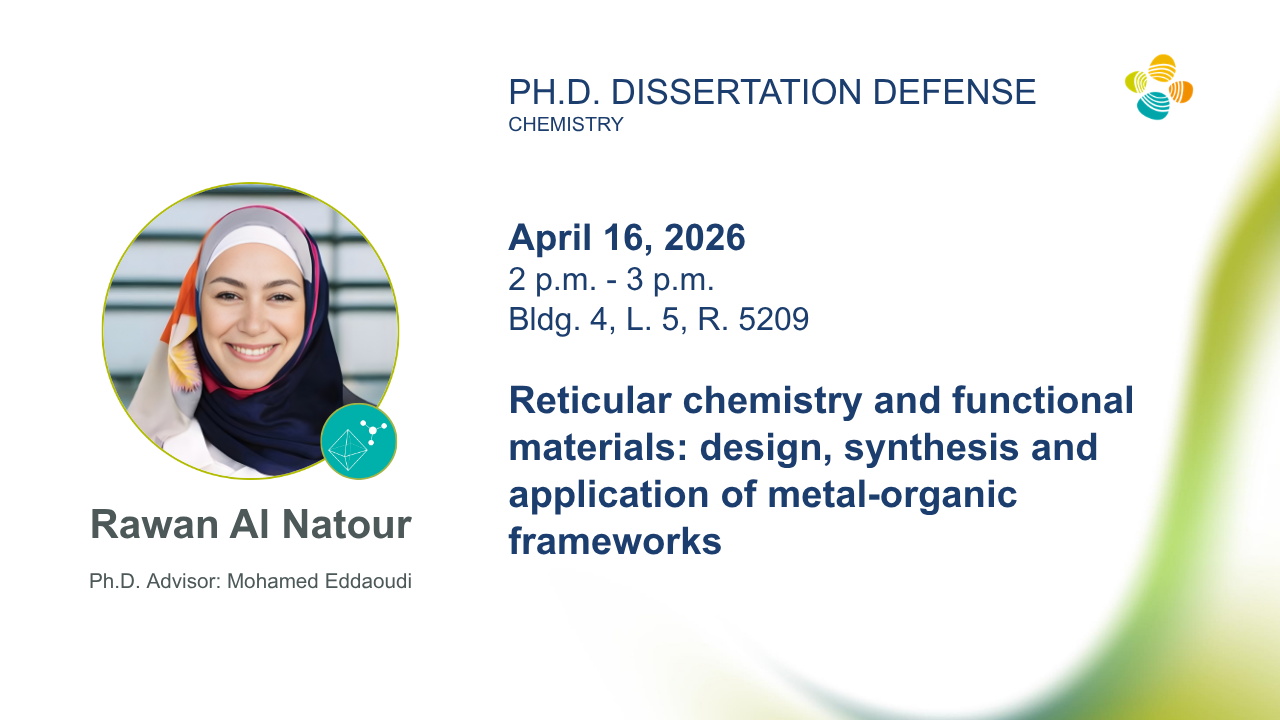
- Ph.D. Advisor: Professor Mohamed Eddaoudi (KAUST Chemistry Program)
- External Examiner: Professor Omar K. Farha (Department of Chemistry, Northwestern University)
- Committee Chair: Professor Ingo Pinnau (KAUST Chemical Engineering Program)
- 4th Committee Member: Professor Cafer Yavuz (KAUST Chemistry Program)
Abstract
Metal−organic frameworks (MOFs) have emerged as a uniquely versatile class of porous materials whose structures can be modularly tuned, through reticular design principles, to control specific pore sizes, window apertures, framework densities or internal chemical environments for various targeted applications. This level of structural tunability enables MOFs to address adsorption or separation challenges that are often difficult to overcome with conventional porous materials.
The work begins by leveraging the design toolkit of the supermolecular building layer (SBL) approach to construct ordered mixed-linker MOFs, in which one linker directs the formation of layers, while a second linker dictates the pillaring mode that ultimately defines the overall three-periodic topology. This modular approach further enables access to the synthesis of isoreticular series, where pore expansion and aperture tuning are achieved systematically without compromising the integrity of the framework.
Building upon these mixed-linker systems, this thesis further addresses morphology control by transforming selected mixed-linker MOFs from bulk single crystals into their respective nanosheets, exposing a preferred crystallographic orientation. This face-selective exposure is employed to direct diffusion through smaller apertures of the pillared MOFs and, upon incorporation into mixed-matrix membranes, unlocks propane/propylene separation that was previously inaccessible in its bulk form.
Beyond the SBL approach, this thesis introduces, for the first time, a complementary design approach based on supermolecular building rods (SBRs), where one-periodic, preassembled rod-like motifs are generated by repetitive cluster bridging, then subsequently cross-linked to yield three-periodic frameworks. By combining various metal clusters with judicious choice of linkers, the SBR approach offers a powerful strategy to yield rods with well-defined points of extension and provides a novel route to eliminate interpenetration while preserving the topology of frameworks.
Finally, this thesis extends Zr-sod-ZMOF-1 into its isoreticular series by systematically elongating the bent linker while preserving the same cantellation-driven “locking”, yielding Zr-sod-ZMOF-3. Such linker expansion served to enlarge the cages and windows to generate a lower-density sod-ZMOF with higher accessible porosity. The parent and expanded analogue are then evaluated as methane and oxygen storage candidates, allowing direct assessment of how pore enlargement and framework density translate into practical gas-storage metrics.