Apr 2026
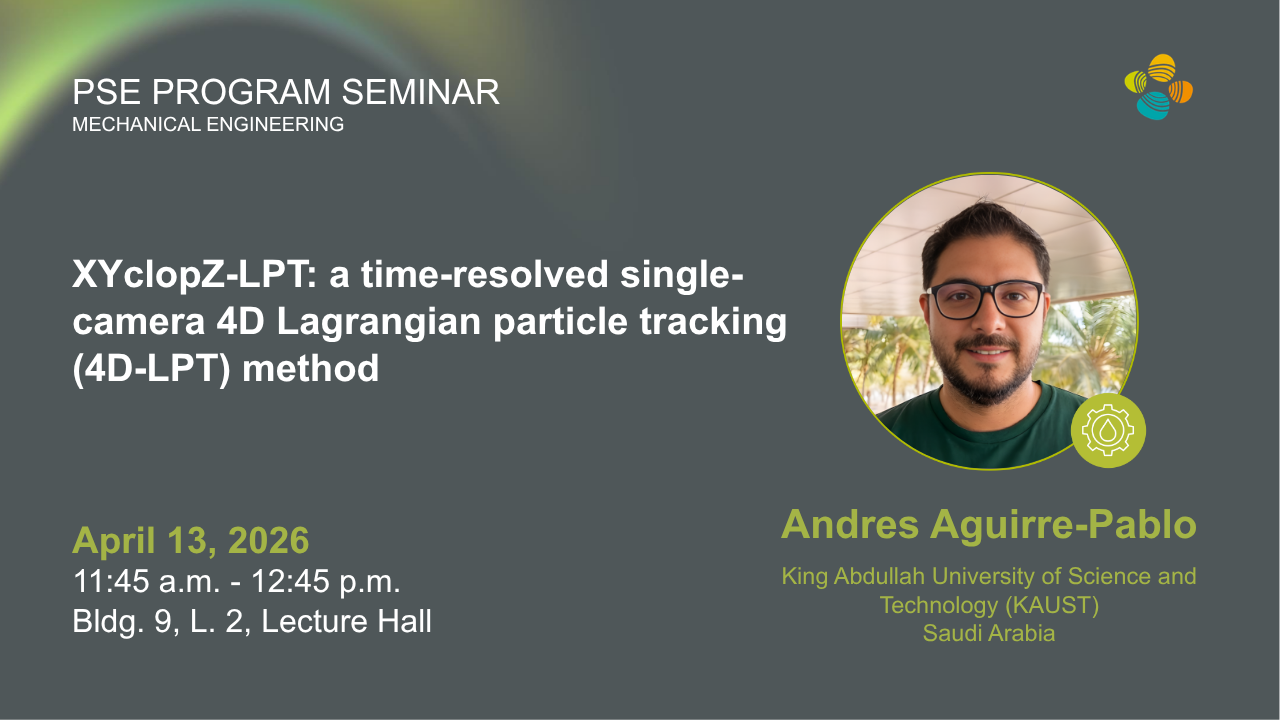
XYclopZ-LPT: a Time-Resolved Single-Camera 4D Lagrangian Particle Tracking (4D-LPT) method
Abstract
In this seminar, I will introduce a novel single-camera, four-dimensional Lagrangian particle tracking (4D-LPT) technique that resolves the complete three-dimensional trajectories of tracer particles within rapidly evolving, time-resolved flow fields. Unlike traditional multi-camera volumetric methods, this approach dramatically simplifies the experimental setup while maintaining high accuracy and temporal resolution.
The system consists of a single high-speed video camera paired with a monochromatic spatial light modulator positioned orthogonally to the imaging axis. This compact optical configuration enables true volumetric velocity measurements at acquisition rates approaching 2000 frames per second. In-plane particle locations are extracted using conventional 2D tracking algorithms, while the out-of-plane (depth) coordinate is reconstructed in real time from the temporally modulated intensity gradients created by the structured illumination pattern.
A streamlined, one-time calibration procedure—requiring only a tilted target with fiducial markers—simultaneously determines both the spatial mapping and the precise intensity-to-depth relationship needed for accurate 3D reconstruction. Validation on synthetic data demonstrates excellent performance, with a median absolute error in depth estimation below 1.5 % even at moderate particle image densities of 0.0125 particles per pixel (ppp). The technique, named XYclopZ after the one-eyed Cyclops of Greek mythology, was rigorously benchmarked in simultaneous experiments against a state-of-the-art four high-speed camera 4D-LPT system, showing outstanding agreement and robustness across a wide range of conditions.
Practical demonstrations include volumetric measurements of the complex flow around live corals and the intricate rotating flow inside a counter-rotating Von Kármán device. By significantly reducing hardware complexity, cost, and alignment challenges compared with tomographic PIV and Shake-The-Box (STB) methods, XYclopZ opens the door to accessible, high-resolution volumetric flow diagnostics in resource and space limited environments.
This talk highlights applications across experimental fluid dynamics, microfluidics, biological flows, with potential applications for industrial sectors including aerospace, automotive, energy systems, and biomedical engineering. The method’s simplicity and performance make it a powerful new tool for advancing both fundamental research and applied engineering challenges.
Biography
Dr. Andres A. Aguirre-Pablo is currently a Research Scientist at the High-Speed Fluids Imaging Laboratory at KAUST. He holds a Ph.D. in Mechanical Engineering from KAUST class of 2018 and he specializes in Flow Visualization & Measurements, high-speed imaging, and 3D sensing techniques. He has industrial experience in the oil & gas sectors, where he acted as Senior Researcher in the R&D department of a leading manufacturer of steel pipes for the energy sector.
His research focuses on qualitative flow visualization methods such as Laser Induced Fluorescence (LIF) and the development of quantitative flow visualization methods, including Particle Image Velocimetry (PIV), Particle Tracking Velocimetry (PTV), tomographic PIV, and rainbow particle imaging velocimetry applied to complex fluid dynamics such as turbulence, microfluidics and cavitation phenomena. Dr. Aguirre-Pablo’s innovative work, often using accessible tools like smartphone-based imaging and single camera methods for full 3D flow velocity measurements, has advanced high-speed 3D velocity measurements and lower the entry bar to fluid dynamics measurements to a broader audience. Two of his proposed methods have been granted patents and have potential applications in different fields such as energy, automotive, aerospace and bio-flows.