Apr 2026
Emergent Magnetic Phenomena
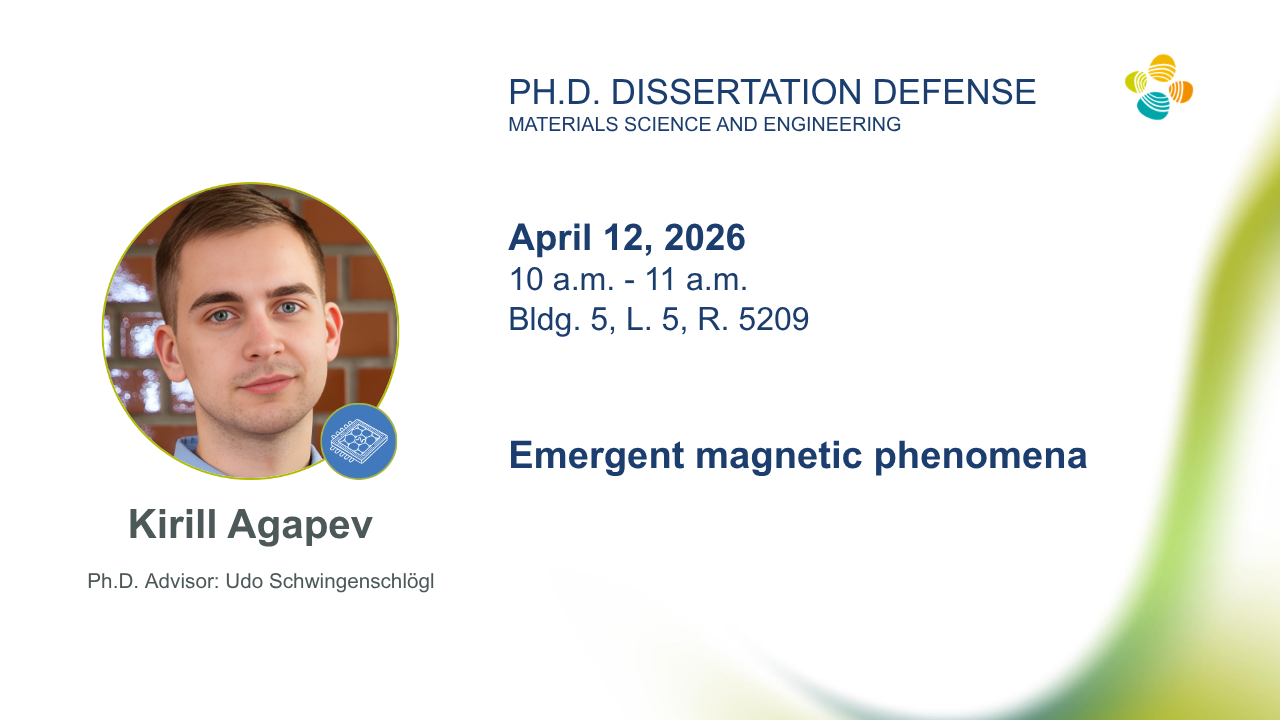
Ph.D. Dissertation Defense Committee:
- Ph.D. Advisor: Prof. Udo Schwingenschlögl
- Committee Chair: Prof. Luigi Cavallo
- External Examiner: Prof. Vlado Lazarov
- Committee Member: Prof. Stefaan De Wolf
- Committee Member: Dr. Fabrizio Cossu
Zoom link: https://kaust.zoom.us/j/8753872697?omn=93201231202
Abstract:
This dissertation investigates the electronic and magnetic properties in low-dimensional correlated materials, focusing on transition metal dichalcogenides (TMDs) and perovskite oxides. Reduced dimensionality, epitaxial strain, and symmetry breaking are shown to strongly influence orbital occupation, charge distribution, and magnetic ordering, enabling the stabilization of novel phases that are absent in bulk systems.
Using first-principles density functional theory calculations and spin-polarized simulations, the interplay between structural distortions, charge and orbital degrees of freedom, and magnetic interactions is analyzed. In monolayer 1H-NbSe2, biaxial and uniaxial strains tune the competition between charge density waves and magnetism, with certain biaxial strain conditions allowing their coexistence. In (001)-oriented LaMnO3 thin films, slabs, and superlattices, epitaxial strain, octahedral tilting, and charge/orbital ordering govern the evolution of magnetic states, while surface and interface reconstructions lead to deviations from the bulk behavior. Extending these studies to (111)-oriented LaMnO3|SrTiO3 superlattices highlights thickness-dependent orbital physics, nearly flat electronic bands, and the stabilization of correlated states through Hund’s coupling and quantum confinement.
Together, these investigations demonstrate how strain, reduced dimensionality, and orbital engineering can control electronic and magnetic properties in complex correlated systems. The results provide fundamental insights into the mechanisms governing the interplay of symmetry, charge, orbital, and spin degrees of freedom, offering guiding principles for designing functional materials and devices based on low-dimensional TMDs and oxide heterostructures.