Apr 2026
Understanding Interfaces in Perovskite Solar Cells through Theory and Experiment
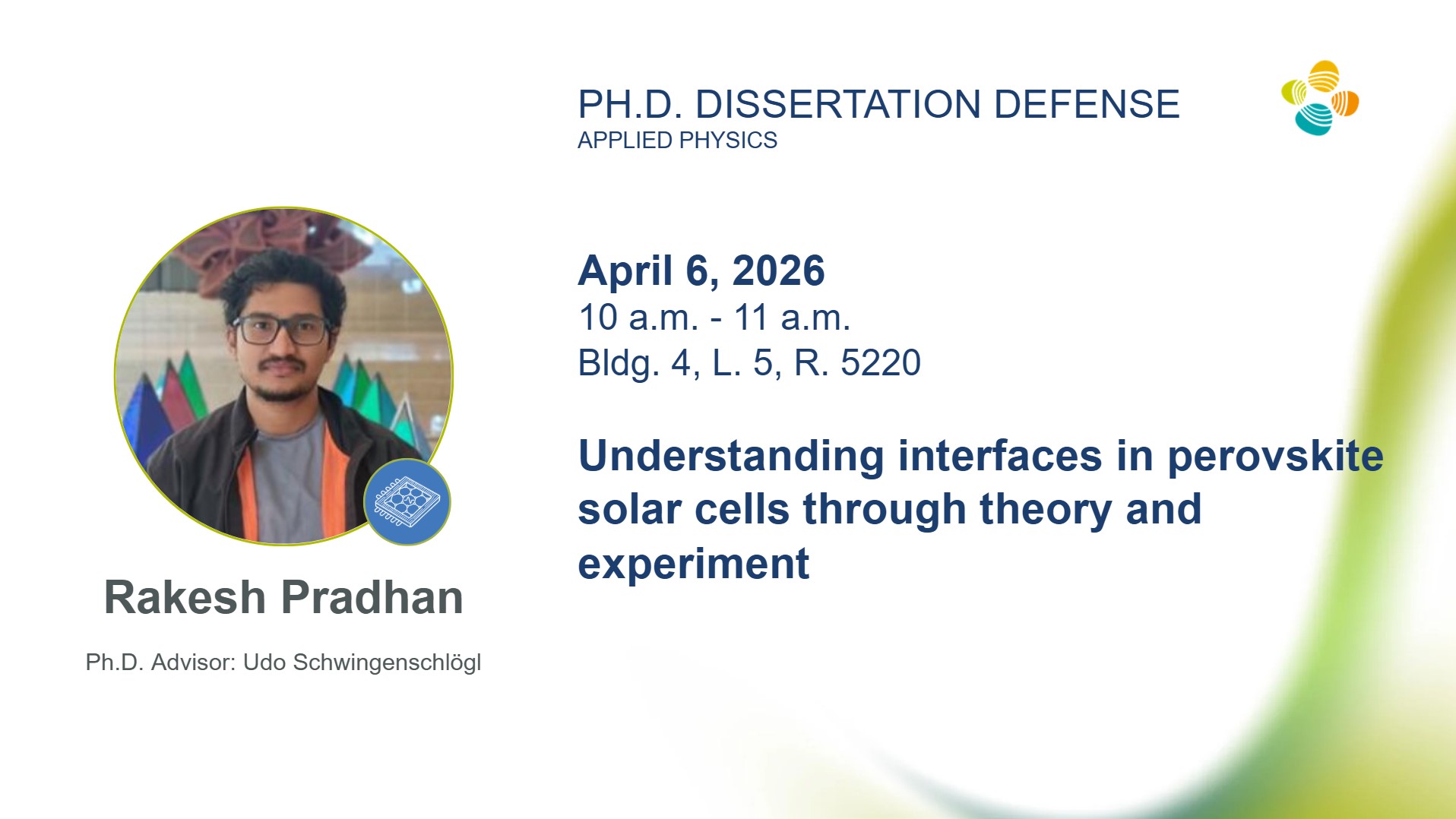
Ph.D. Dissertation Defense Committee:
- Ph.D. Advisor: Prof. Udo Schwingenschlögl
- Committee Chair: Prof. Khaled Nabil Salama
- External Examiner: Prof. John Andreas Larsson
- Committee Member: Prof. Stefaan De Wolf
Abstract:
Perovskite solar cells have rapidly advanced in efficiency, however, further progress is limited by losses arising from non-radiative recombination at interfaces between the perovskite absorber and charge transport layers. This thesis combines theoretical prediction with experimental validation to understand and engineer perovskite interfaces for improved solar cell efficiency and operational stability.
Using density functional theory it is shown that charge-transport layers and metal contacts can induce electronic states within the bandgap of the perovskite, leading to losses in the open-circuit voltage. Mitigation strategies are developed using molecular or cationic interlayers and thin oxide barriers. In addition to contact-induced states, intrinsic surface defects are also critical. A density functional theory based screening study is executed. The study shows the organic ammonium cations that can passivate MAPbI3 surfaces, and are electronically benign while introducing a shift of the workfunction due to the induced dipole. Because the surface termination determines the workfunction, termination and passivation must be jointly selected to achieve optimal energy-level alignment between the absorber and charge-transport layers. Self-assembled monolayers, including 2PACz and N719, are investigated as charge-transport layer in order to study how it binds to the absorber as well as electrode and how the induced dipole affects the interfacial energetics. Guided by theoretical insights a binary solvent processing strategy is developed to control the residual surface species. Optimizing the solvent is found to reduce the excess surface cations on the perovskite film, which minimizes the interfacial nonradiative recombination. The developed strategy resulted in single-junction device with 26.1% power conversion efficiency and enhanced thermal and operational stability.
Overall, the obtained results demonstrate how close synergy between theory and experiments can unravel interface phenomena to enable technological improvements. The findings aid the interface engineering in perovskite solar cells to push up the stability and performance.