Apr 2026
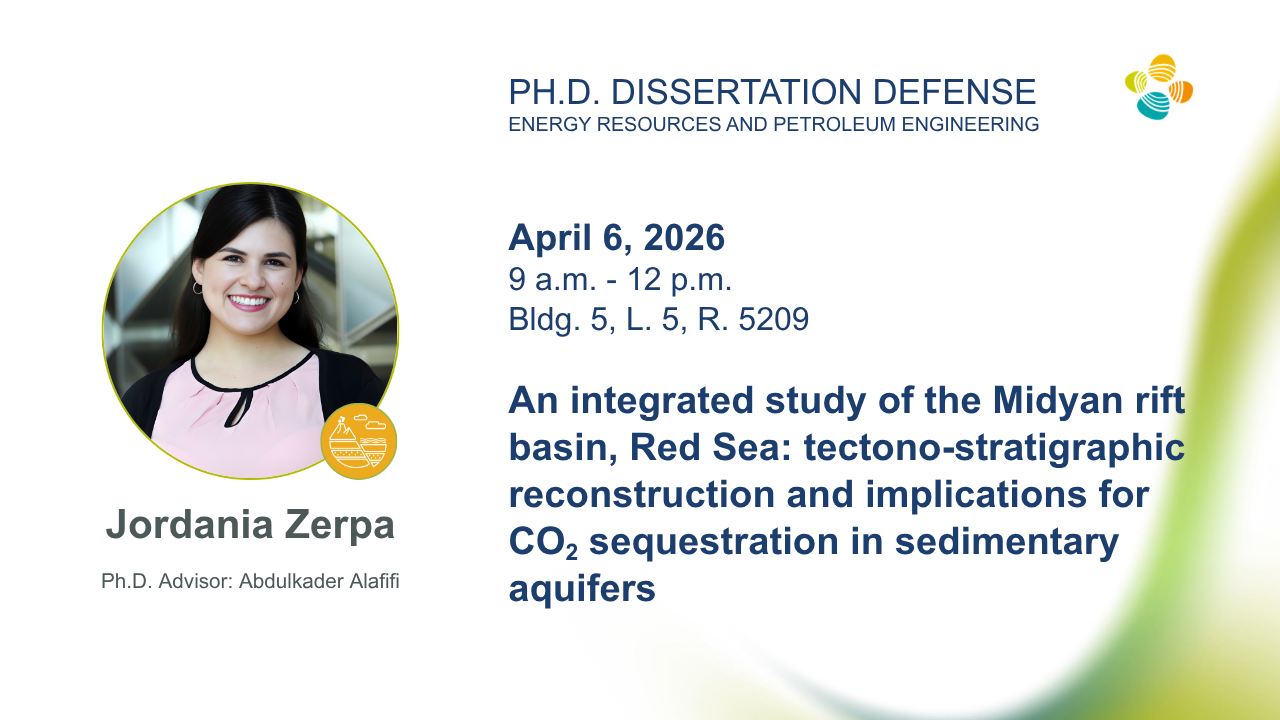
An integrated study of the Midyan rift basin, Red Sea: tectono-stratigraphic reconstruction and implications for CO2 sequestration in sedimentary aquifers
Committee Members Information
- Ph.D. Advisor: Prof. Abdulkader Musa Alafifi
- External Examiner: Dr. Khalid Alramadan
- Committee Chair: Prof. Ibrahim Hoteit
4th Committee Member: Prof. Hussein Hoteit
Abstract
Large stationary CO₂ sources along the northern Red Sea margin, and the need to assess subsurface resources and hazards in basins with restricted public-domain data access, motivate improved geological understanding of the Midyan Basin (northwestern Saudi Arabia). Despite its exceptional onshore exposure, the basin’s tectono-stratigraphic evolution has not yet been comprehensively synthesized, and the subsurface record that is publicly accessible remains incomplete and inconsistently integrated into the regional framework. This thesis addresses this gap by developing an integrated, process-based tectono-stratigraphic framework for Midyan and demonstrating how it can be translated into robust basin-to-site screening for CO₂ geological sequestration in saline aquifers. A major contribution of this work is a unified reconstruction of Midyan Basin evolution from rift initiation (~30 Ma) to the present, explicitly linking structural segmentation, accommodation rate, and facies distribution across syn-rift and post-rift stages. The reconstruction integrates field-based facies and structural observations, compiled regional stratigraphic constraints, remote-sensing imagery to support surface mapping, interpretations of 2D seismic lines, and free-air gravity anomalies as a proxy for long-wavelength basement relief. This synthesis highlights how inherited basement structure organized half-graben architecture, while transfer zones partitioned the rift into segments controlled fault linkage and rift polarity transitions, influencing syn-rift depocenter development and exposure and erosion of basin shoulders. The thesis provides updated basin-scale depositional and architectural models for key units and groups (including fluvio-lacustrine to marginal-marine syn-rift systems, deep-water turbidite systems, sag-phase carbonates and evaporites deposited over and infilling inherited syn-rift topography—including salt deposition and subsequent salt-related deformation—and late transform deformation associated with the Gulf of Aqaba system), establishing a coherent geological narrative for this critical segment of the northern Arabian Plate margin. Building on the tectono-stratigraphic framework developed in this thesis, a screening and ranking workflow is presented to translate basin architecture into CO₂ sequestration-relevant criteria (capacity, injectivity, containment, and uncertainty) for saline aquifers. Candidate saline-aquifer plays are identified and prioritized across two basin domains (M1–M2) by combining structural containment, seal presence, reservoir continuity, and expected boundary-condition behavior. To advance beyond qualitative screening, forward stratigraphic modeling is used as a basin-modeling engine to generate internally consistent stratigraphic architectures and heterogeneity patterns that honor the reconstructed accommodation history and are constrained by boundary conditions (sediment sources, supply rates, and transport pathways) and parameterized process rules (e.g., clastic transport and reworking, carbonate production, and erosion–deposition thresholds). These forward models provide geologically plausible facies distributions and stacking patterns, which are then coupled with 3D static geomodel construction in Petrel, yielding a seismic-consistent structural grid populated with process-consistent facies and first-order porosity–permeability architectures. Petrophysical properties are constrained using the closest available analogs and calibrated to remain consistent with the expected depositional texture and diagenetic tendencies of each system. Reservoir dynamic performance is quantified using EOS-based compositional CO₂–brine simulation in CMG-GEM under pressure-constrained operating conditions (surface-rate control with a bottom-hole-pressure cap below estimated fracture pressure) for a 100-year injection period followed by a 1000-year post-injection monitoring period. Two syn-rift reservoir targets are compared: the Burqan Formation (deep-marine sand systems) and the Al Wajh Formation (heterogeneous fluvio-lacustrine systems). The results define the operational limits, revealing a transition from rate-controlled injection to pressure-limited behavior once the bottom-hole-pressure constraint becomes active, and show that plume evolution and vertical redistribution depend strongly on the formation target. CO₂ injected into the Burqan Formation remains largely confined to the intended interval, whereas injection into the Al Wajh Formation promotes upward redistribution and localized transfer into the basal Burqan Formation, requiring monitoring of both the Al Wajh and Burqan intervals and the intervening seals. Trapping partitioning during post-injection monitoring is highly sensitive to relative-permeability hysteresis, underscoring the need to report uncertainty envelopes even when pressure response and plume geometry appear stable. The thesis delivers a basin-scale tectono-stratigraphic synthesis that strengthens regional geological understanding of the northern Red Sea margin of Arabia, and a transferable geology–forward-modeling–to–simulation workflow for first-order sequestration assessment in basins with restricted public-domain access to subsurface data, explicitly highlighting uncertainties that control injectivity, containment, and long-term immobilization.
-jpgf64a5d6c-a745-4a2a-882b-e4f50364e8d3.jpg?sfvrsn=439c23b6_2)