Mar 2026
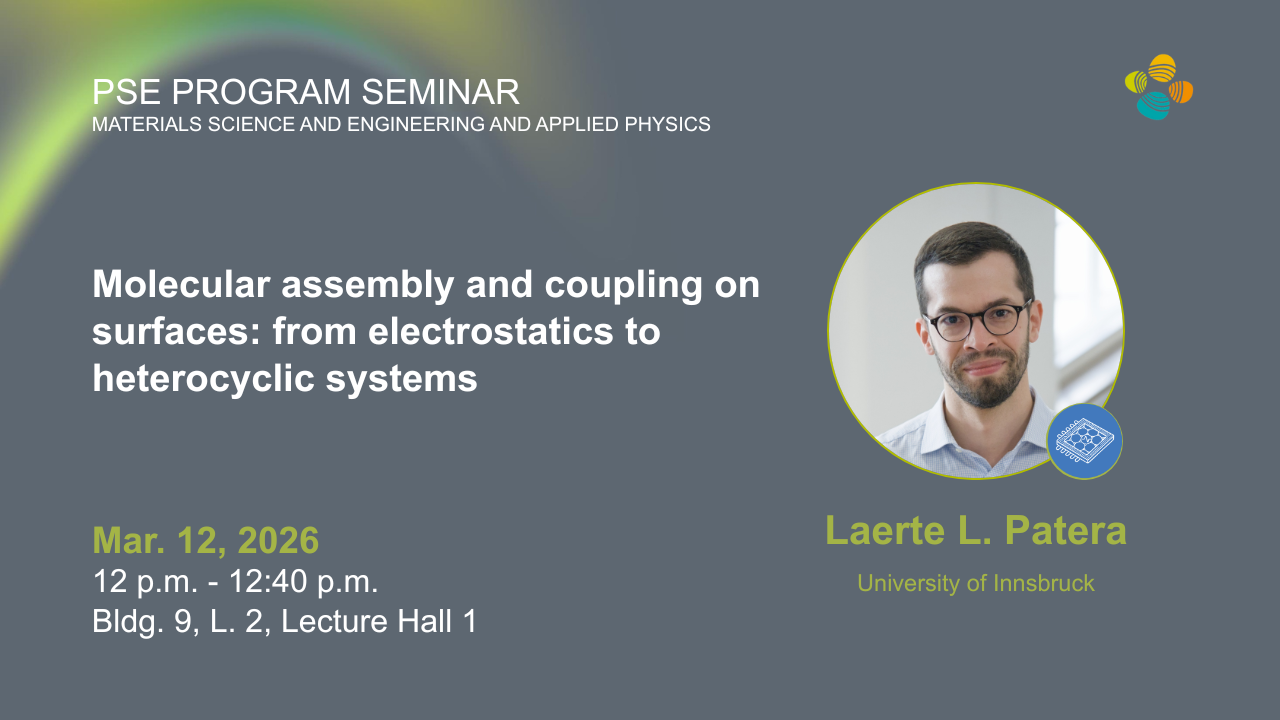
Molecular Assembly and Coupling on Surfaces: From Electrostatics to Heterocyclic Systems
Abstract
Understanding the intricate mechanisms governing molecular assembly and coupling on surfaces is essential for advancing surface chemistry and nanotechnology. Here, I will present an exploration of phenomena ranging from electrostatic interactions to the formation of heterocyclic systems, exploiting high-resolution scanning probe microscopy.
The first part will focus on dihydrogen bonding (DHB), a distinctive intermolecular interaction where hydrogen atoms simultaneously act as proton donors and acceptors. Low-temperature scanning tunneling microscopy (LT-STM) reveals single and double DHB motifs within borazine assemblies on Au(111) surfaces. Complementary density functional theory (DFT) calculations provide critical insights into the interplay between substrate adsorption and intermolecular forces, elucidating the stabilization mechanisms driving the formation of borazine clusters.
The second part will examine the self-assembly of fullerene C60 and Zn(II)-5,10,15,20-tetrakis(4-aminophenyl)porphyrin (ZnTAPP) on a Ag(111) surface. Kelvin Probe Force Microscopy (KPFM) and Scanning Tunneling Spectroscopy (STS) unveil the intricate role of charge transfer and Coulomb interactions in shaping intermixed molecular phases. Notably, the alleviation of repulsive inter-fullerene Coulomb forces promotes the formation of row-like structures, which, in turn, enhance charge transfer to C60 molecules. These findings highlight the delicate balance between substrate-mediated electron transfer and intermolecular forces in directing molecular self-assembly.
The final part will demonstrate the on-surface synthesis of nitrogen-containing heterocycles, which are fundamental building blocks in biomolecules and pharmaceuticals. Thermal activation of a tailored precursor leads to the formation of an N-heterocyclic compound, as visualized by high-resolution non-contact atomic force microscopy (nc-AFM). DFT calculations reveal the reaction mechanism, emphasizing the critical role of hydrogen release as the driving force behind the transformation.
Biography
Laerte L. Patera is an assistant professor at the University of Innsbruck (Austria) since 2022. He obtained his Ph.D. in Nanotechnology from the University of Trieste (Italy) in 2016 and then pursued postdoctoral research at the University of Regensburg (Germany) in the group of Jascha Repp from 2016 to 2019. In 2020, he started his independent research career at the Technical University of Munich (Germany). He received the Gustav Hertz Prize from the German Physical Society in 2019 and was awarded an ERC Starting Grant in 2021.