Mar 2026
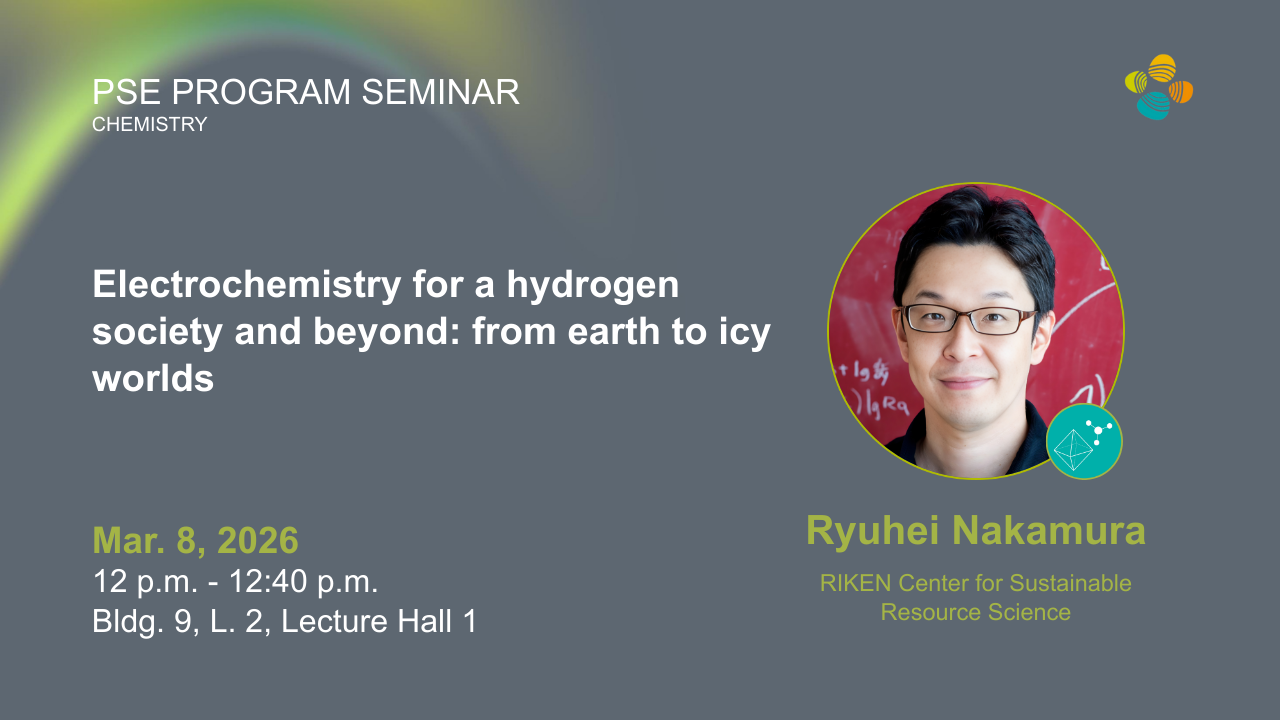
Electrochemistry for a Hydrogen Society and Beyond: From Earth to Icy Worlds
Abstract
Water is the most abundant liquid on Earth and underpins the global carbon cycle balanced by photosynthesis and respiration. Replicating nature’s water-based carbon cycle through science and technology offers a fundamental solution to energy, environmental, and climate changes. Our work explores how water electrochemistry can operate in very different environments. On Earth, we aim to support a hydrogen-based society by developing water electrolysis systems that work under real industrial conditions. These include changing voltages from renewable power sources and a wide range of water qualities, from ultrapure water to seawater. We also look beyond Earth. We investigate water electrochemistry at low and subzero temperatures, relevant to polar regions and to icy moons such as Enceladus, where liquid water may exist under thick ice. These studies raise basic questions: How does water behave as an electrochemical medium at very low temperatures? Can hydrogen be produced under such conditions? Could such processes be related to the origin of life? This talk will present water electrochemistry as a common framework that connects hydrogen technology, planetary environments, and the possibility of life beyond Earth.
References
- 1. T. Lim*, H. Ooka, Y. Yu, T. Murakami, S, Wada, R. Nakamura*, Hydration entropy of cations regulates chloride ion diffusions during electrochemical chlorine evolution, Nature chemistry, 2025, DOI: 10.1038/s41557-025-02014-4
- A. Li*, R. Nakamura* et al., Oxygen Evolution Catalysis by Manganese Oxides Resilient to Voltage Fluctuations, Nature Sustainability, 2025, DOI: 10.1038/s41893-025-01665-y
- A. Li, et al., Atomically dispersed hexavalent iridium oxide from MnO2 reduction for oxygen evolution catalysis. Science, 2024. DOI: 10.1126/science.adg5193
- S. Kong, R. Nakamura* et al., Acid-stable manganese oxides for proton exchange membrane water electrolysis, Nature Catalysis, 2024. 10.1038/s41929-023-01091-3
- H. Lee, et al., Osmotic Energy Conversion in Deep-Sea Hydrothermal Vents, Nature Communications, 2024, 15: 8193. DOI: 10.1038/s41467-024-52332-3
- H. Lee*, M. Russell*, R. Nakamura*, Water Chemistry at the Nanoscale: Clues for Resolving the “Water Paradox” Underlying the Emergence of Life, ChemistryEurope, 2024, 2, e202400038. DOI: 10.1002/ceur.202400038
- A. C. Wardhana, R. Nakamura* et al., Cooling water to near freezing breaks the activity-stability trade-off of water oxidation catalyzed by manganese oxides, ChemRxiv, 2025, DOI: 10.26434/chemrxiv-2025-99mx9
Biography
Ryuhei Nakamura is Team Director at RIKEN Center for Sustainable Resource Science and Professor at the Earth-Life Science Institute (ELSI), Institute of Science Tokyo. His research bridges electrochemistry, microbiology, and geology to tackle two grand challenges: sustainable energy conversion and the origin of life.
After earning his Ph.D. from Osaka University in 2005, he worked at Lawrence Berkeley National Laboratory as a JSPS Fellow and later joined The University of Tokyo as Assistant Professor. Since 2013, he has led efforts at RIKEN to design biologically and geologically inspired catalysts, including earth-abundant water-splitting systems essential for a carbon-neutral society. In parallel, at ELSI, his group investigates energy-harvesting strategies in deep-sea ecosystems and mineral-based reactions that sustain life without sunlight. By reconstructing these processes and their evolutionary trajectories, his team seeks to uncover principles that governed life’s emergence. This work is closely tied to a broader scientific goal: understanding how life originated on Earth and beyond.