Feb 2026
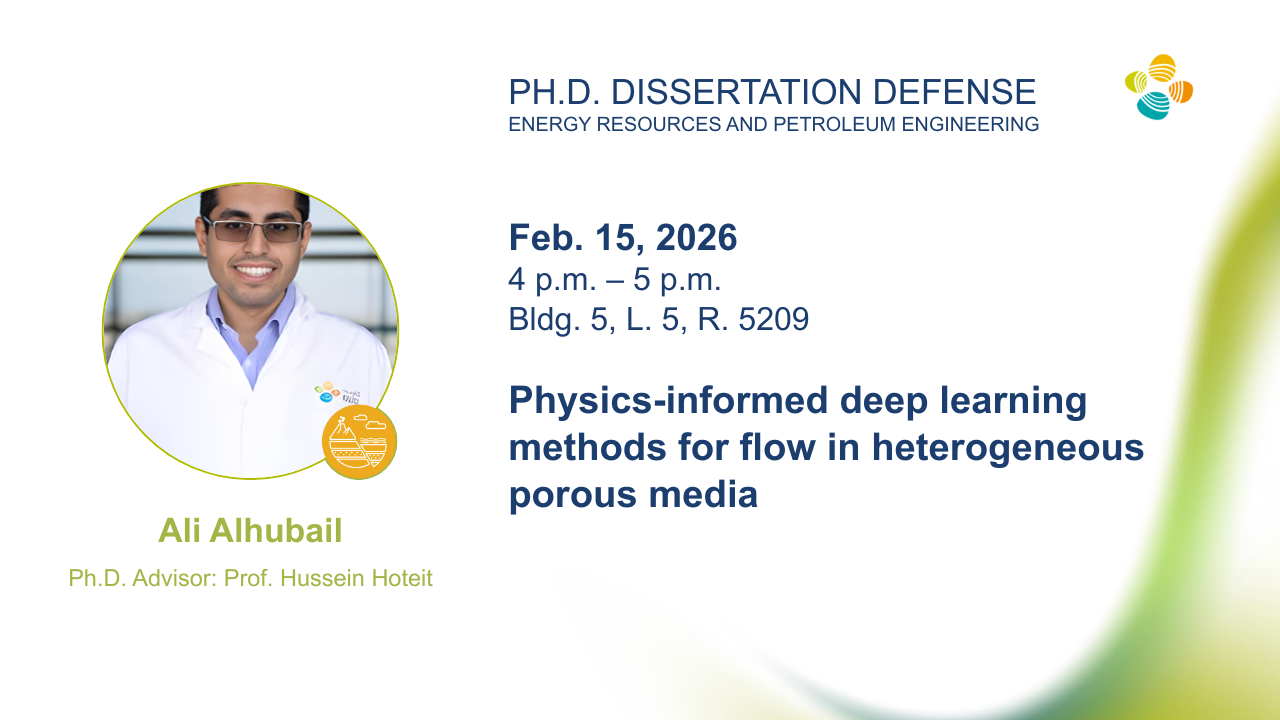
Physics-Informed Deep Learning Methods for Flow in Heterogeneous Porous Media
Abstract
The simulation of fluid flow through porous media is fundamental to a wide range of engineering and environmental applications, including groundwater management, contaminant remediation, hydrocarbon recovery, and geological carbon sequestration. Accurate prediction of pressure distributions and velocity fields in these systems is essential for informed decision-making and risk assessment. Physics-Informed Neural Networks (PINNs) have emerged as a promising mesh-free alternative for solving partial differential equations (PDEs) by embedding governing physical laws directly into the loss function of a neural network. However, the application of standard PINNs to subsurface flow encounters a fundamental obstacle due to the inherent heterogeneity of geological formations. Spatial variations in rock properties, such as hydraulic conductivity, often manifest as sharp discontinuities at interfaces between geological layers. These discontinuities pose a critical challenge for standard PINNs because automatic differentiation produces inaccurate gradients across discontinuous hydraulic conductivity fields. This dissertation focuses on developing and validating robust physics-informed deep learning frameworks for simulating fluid flow in heterogeneous porous media with discontinuous properties. First, we introduce mixed formulation PINNs, which decouple the continuity equation from Darcy's law to circumvent the need for differentiating the hydraulic conductivity field. This formulation is validated against analytical solutions and finite element reference solutions, demonstrating its ability to handle sharp discontinuities that cause standard PINNs to fail. We then conduct a comprehensive study of weighting methods to address optimization challenges arising from multi-term loss functions. Seven weighting techniques, spanning both global and local strategies, are evaluated across homogeneous, stochastically heterogeneous, and block-heterogeneous domains. Finally, the Deep Ritz Method is explored as an alternative paradigm that minimizes the variational energy functional rather than PDE residuals, thereby reducing the required order of differentiation. This energy-based approach demonstrates efficacy for handling complex geometries and singular sources such as wells. These contributions advance the applicability of scientific machine learning to real-world porous media problems characterized by strong heterogeneity and discontinuous material properties.