Feb 2026
Chemistry Student Seminar
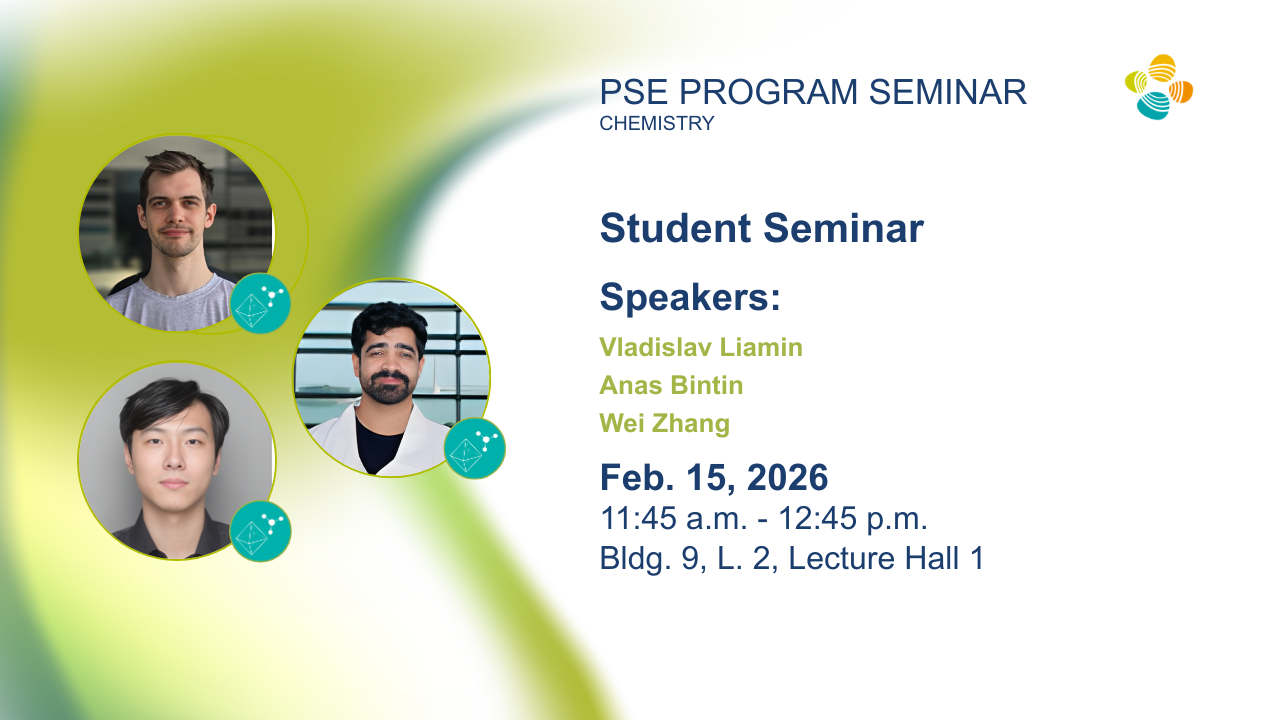
By: Vladislav Liamin
Ce-Doped Fe Catalyst for Photothermal Conversion of CO2 to Carbon Fibers
Abstract
Potassium-promoted iron-based catalysts have long been used for CO₂ hydrogenation in conventional thermal processes such as the reverse water–gas shift (RWGS) and Fischer–Tropsch (FT) reactions. These Fe-based materials have also shown promise under photothermal operation, although relatively few studies have focused on iron catalysts in photothermal CO₂ conversion. In this work, we investigate the effect of cerium (Ce) doping on a K–Fe catalyst under photothermal CO₂ hydrogenation conditions (200 °C, 20 bar, visible light). The presence of Ce significantly alters the product selectivity, with its impact varying according to the Ce content in the catalyst. Notably, cerium promotion shifts the reaction pathway: instead of generating mainly hydrocarbons, the Ce-doped catalyst produces carbon nanotubes as the predominant carbon product. This demonstrates that Ce can steer CO₂ hydrogenation toward solid carbon formation, highlighting the tunability of photothermal catalytic processes for producing carbon nanomaterials.
Biography
I obtained my both BSc and MSc in Chemistry from Saint Petersburg State University in Russia in 2021 and 2023, respectively. During my graduate studies, I mostly worked on polymeric membranes for separating liquid components via pervaporation.
Currently, I am a PhD student working on conversion of CO2 into carbon materials with photothermal catalysis, under the supervision of Prof. Jorge Gascon Sabate.
By: Anas Bintin
Ni-Zn Mixed Oxides Enable Tunable Syngas Ratio in High-Rate CO2 Electrolysis
Abstract
Electrochemical CO2 reduction offers a pathway to close the carbon cycle by converting captured CO2 into fuels and value-added chemicals. However, industrial deployment is limited by selectivity loss, and interfacial instability leading to prohibitively high CO2 utilization costs. The recurring challenge has been the suppression of the hydrogen evolution reaction. In practice, the unavoidable co-production of H2 can be leveraged to directly generate syngas, a key feedstock for sustainable fuels and chemicals. Scalable CO2 electrolyzers therefore require control rather than the elimination of H2 production under high-rate operation. Here, we demonstrate that mixed Ni-Zn oxide catalysts provide the basis for modulating the interfacial reaction environment through coupled control of catalyst composition and electrolyte chemistry in gas diffusion electrodes. Benchmark Ag and ZnO catalysts confirm the strong correlation between pH and current density on the syngas ratio. By jointly tuning the catalyst composition and electrolyte pH we achieve a stable continuously tunable syngas ratio at current densities of 100 mA/cm2.
Keywords: CO2 electrolysis, gas diffusion electrodes, mixed metal oxides, syngas electrosynthesis.
Biography
Anas Bintin holds a Bachelor’s degree in Mechanical Engineering from the University of Birmingham, UK (2015), and a Master of Science in Refining and Petrochemicals from IFP School, France (2017). He has over ten years of experience at Saudi Aramco, where he has worked as a gas processing project engineer and a sustainable energy research engineer. His work focuses on energy systems, process engineering, and the development of advanced technologies for sustainable and low-carbon energy applications.
By: Wei Zhang
High-capacity hydrogen storage in flexible alkane-linked porous aromatic network polymers
Abstract
Hydrogen (H2), as a highly promising clean energy carrier, has been widely regarded by both academia and industry as the “ultimate energy.” However, the safe, efficient, and cost-effective storage of hydrogen under ambient conditions remains a major challenge, as it typically requires high-pressure compression, cryogenic temperatures, or specialized storage materials. To address this challenge, the development of flexible porous polymer materials that undergo reversible structural responses during hydrogen adsorption, thereby enhancing storage efficiency, is considered a key strategy for overcoming the limitations of conventional hydrogen storage technologies.
In this work, we report a new alkane-linked porous aromatic network polymer that exhibits a hydrogen uptake of up to 1 wt% at room temperature. The polymer is synthesized from toluene and dichloroethan, and its unique flexible structure endows it with high H2 working capacity, fast adsorption-desorption kinetics, and good cycling stability. Although further characterization and performance evaluation are still ongoing, the combination of low cost and facile synthesis, high hydrogen storage capacity, and robust stability highlights this material as a highly promising candidate for practical hydrogen storage applications.
Biography
Wei Zhang joined Prof. Cafer T. Yavuz’s group in 2023 and has been working on developing and testing of hydrogen storage materials since then.