Feb 2026
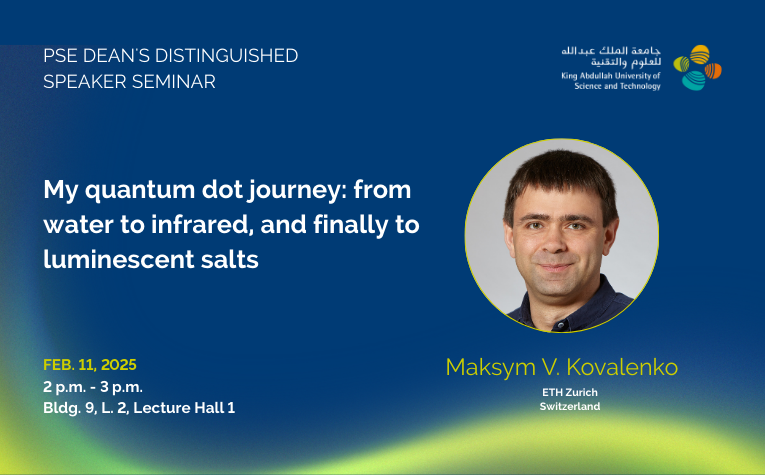
My quantum dot journey: from water to infrared, and finally to luminescent salts
Abstract
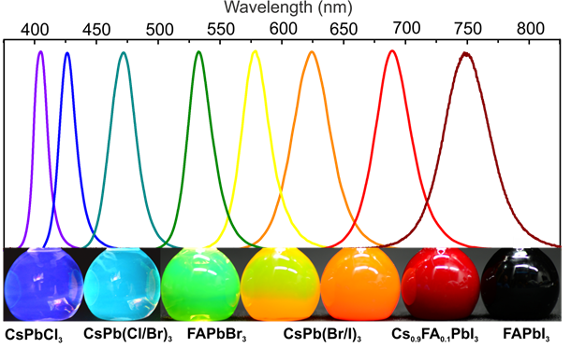
My QD journey began in 2000, when I sought to escape the monotony of growing single crystals of CdTe. Instead, I opted to produce thiol-capped CdTe QDs in water and study their photoluminescence. In Austria, my future PhD advisor was very enthusiastic about extending QD studies into the near- and mid-infrared. By 2008, the primary challenge was to integrate QDs into solid-state devices, and the key was to rethink the way we design their capping ligands – a task undertaken during my postdoctoral experience at the University of Chicago. Finally, in 2015, it was time to invent a new kind of QDs, this time in the realm of ionic materials. Inspired by the success of lead halide perovskites (APbX3, A=Cs, methylammonium, and formamidinium) as highly intrinsic and defect-tolerant semiconductors, we set out to produce QDs of the same composition in 2014. These novel QDs turned out to be vastly different from all other QD materials, as they did not require epitaxial overcoating to exhibit highly efficient and spectrally narrow photoluminescence in the visible spectral range. These QDs are currently pursued as superb green and red primary emitters in LCD displays. We will discuss the peculiar chemistry of perovskite QDs, stemming from their soft ionic nature, and a new approach developed for their surface coating. Low-temperature studies of perovskite quantum dots, initiated in 2016, have revealed a unique set of desirable optical properties of a quantum emitter: ultrafast radiative rates (down to 100 ps) and long exciton coherence times of approximately the same value. Perovskite QDs are thus the first colloidal QD material of high potential as a source of indistinguishable photons, as required for diverse protocols of optical quantum computing. The integration of such coherent emitters into a three-dimensional, periodic superlattice yields ultrafast superradiant emission (10-30 ps). We will discuss the factors that govern the radiative rates in perovskite quantum dots and how to engineer their collective emission. Finally, we will review the rapid progress in lead-free alternatives, chiefly based on tin.
I am indebted to my group and excellent collaborators for sharing this journey.
Biography
Maksym V. Kovalenko is a full professor of Functional Inorganic Materials at ETH Zurich. He studied chemistry at the Chernivtsi National University in Ukraine from 1999 to 2004. He completed his doctoral studies at the University of Linz, Austria (2004-2007), and his postdoctoral training at the University of Chicago, USA (2008-2011). He then joined ETH Zurich as a tenure-track professor and became a tenured associate professor in 2017; promoted to full professor in 2020. Currently, he serves as the head of the Institute of Inorganic Chemistry.
The research activities of M. Kovalenko and his group focus on chemistry, physics and applications of inorganic solid-state materials and nanostructures. In particular, present research efforts concern: (i) the precision synthesis of highly luminescent perovskite nanocrystals; (ii) nanocrystal surface chemistry and self-assembly; (iii) nanocrystals as quantum light sources; (iv) exploration of novel semiconductor materials by solution- and solid-state synthesis; (iv) novel semiconductors for hard radiation detection; (iv) electrochemical energy storage. Many of these activities are strongly linked to industrial partners. He is also affiliated with Empa (Swiss Federal Laboratories for Materials Science and Technology). To date, Maksym Kovalenko has published over 480 scientific articles, co-authored 3 book chapters, and is listed as an inventor on 21 patents. His h-index is 120 with over 100'000 citations in total, and he has been a Clarivate Highly Cited Researcher since 2018. He has been the recipient of highly prestigious awards, including an ERC Consolidator Grant (2018), ERC Starting Grant (2012), Ruzicka Preis (2013), Werner Prize (2016), Rössler Prize (2019), Dan Maydan Prize (2021) and Wheland Medal (2023). He is a member of the Swiss Academy of Engineering Sciences. He is also an associate editor of the Chemistry of Materials and ACS Materials Au.