Feb 2026
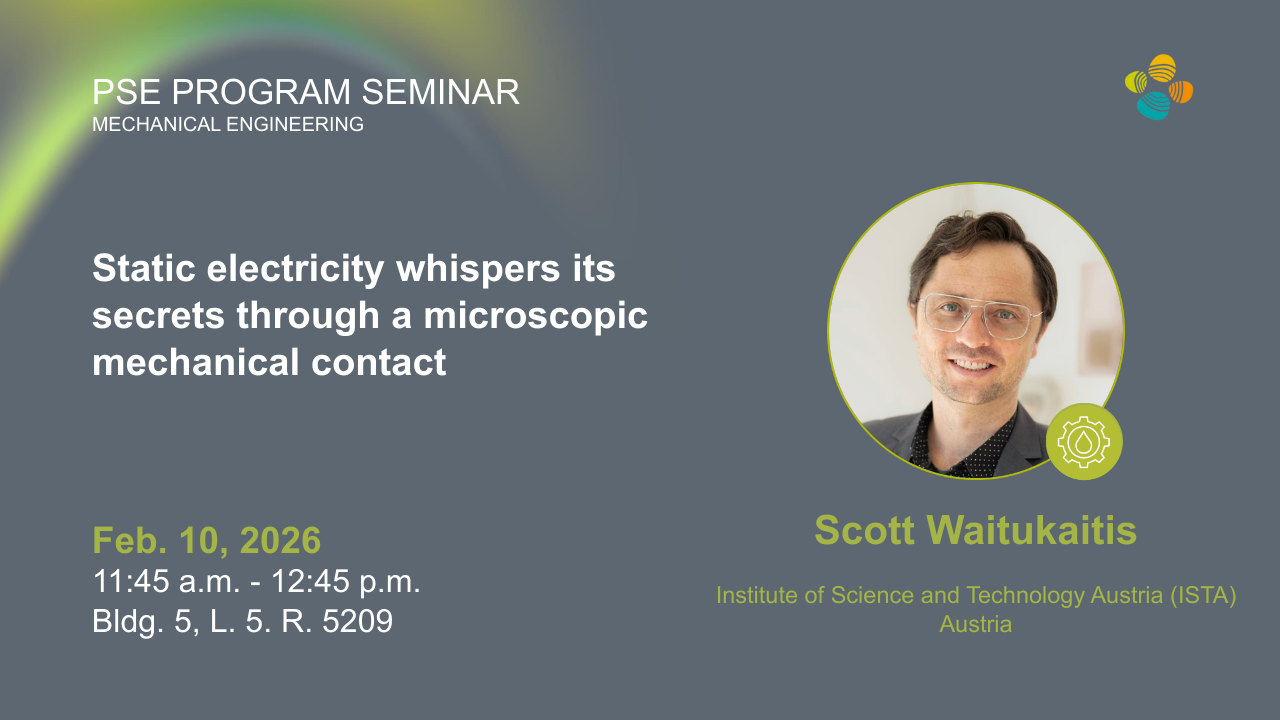
Static electricity whispers its secrets through a microscopic mechanical contact
Abstract
In my group, we study an even trickier aspect of contact electrification: the charge exchange that occurs when identical materials touch, which happens robustly despite the absence of any obvious symmetry-breaking parameter. In this talk, I will discuss our work with identical oxide materials, which are among the most common substances in nature. Working with oxides presents a number of challenges. First, they are extremely hard, which means contact areas, and hence charge exchange, are extremely small. Second, we cannot touch them ourselves when we handle them, or we add unwanted charge that overwhelms what we are trying to measure.
We overcome these challenges using acoustic levitation. Our approach allows us to perform thousands of automated, hands-free contacts and measure charge with a few-hundred-electron resolution on macroscopic samples. Our experiments have led to the discovery that the symmetry breaker in oxide contact electrification lies not in the bulk material, but rather in surface adsorbates—specifically adventitious hydrocarbons acquired from a sample’s environmental history. These findings, now in press at Nature, prime the field for a long-sought mechanistic understanding of the effect, with relevance ranging from desert sandstorms to climate change to planet formation.
Biography
Scott Waitukaitis is an experimental physicist and Assistant Professor at the Institute of Science and Technology Austria (ISTA). He received his PhD in Physics from the University of Chicago, where he was the recipient of the Robert Millikan Fellowship. His research lies at the intersection of soft matter physics and electrostatics, with a particular focus on contact electrification, tribocharging, and electrically active soft materials. He is internationally recognized for developing novel experimental platforms—most notably with acoustic and optical levitation techniques—that enable precise, contact-free measurements of charge transfer at the single-particle and even single-electron level. His work has led to fundamental advances in understanding charge exchange in oxides and polymers, leading to publications in Nature, Nature Physics, PNAS, and Physical Review Letters.
He is the recipient of the 2026 APS Early Career Award for Soft Matter Research, the Springer Thesis Prize, the Block Prize for Outstanding Young Researcher, the Fysica Young Speaker's Award, and the CJ Kok Discoverer of the Year Award. He is a member of the Young Academy of the Austrian Academy of Sciences.
His research has been supported by major competitive funding, including an ERC Starting Grant, a Marie Skłodowska-Curie Doctoral Networks Grant, and a Veni Grant from the Netherlands Organisation for Scientific Research.