Feb 2026
Designing Functional Crystals with Optimal Pore Structures
Abstract
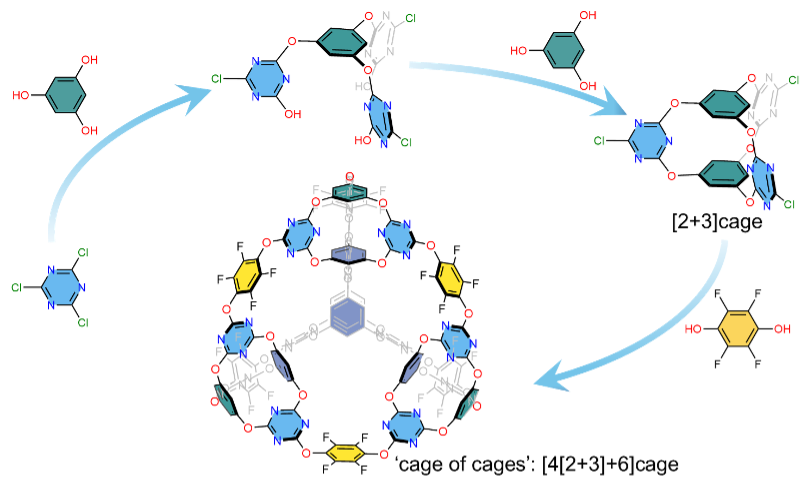
This presentation will focus on the computational design and experimental discovery of porous organic molecular materials,[1] including selectively permeable membranes[2], low-density molecular crystals,[3] and selectively porous organic crystals.[4] I will demonstrate how we have developed organic cages and macrocycles as building blocks for the assembly of porous materials, including covalent organic frameworks,[5] hydrogen-bonded organic frameworks,[6] porous organic cages,[7] and metal-organic polyhedra.[8] In one of these studies, I will show how we developed a two-step, hierarchical synthesis strategy that assembles a trigonal prismatic organic cage into a more symmetric, higher-order tetrahedral cage, referred to as a ‘cage of cages’ (see Scheme).[7] In another related study, I will show how we used trianglsalen macrocycles as preorganised building blocks to assemble octahedral-shaped metal-organic polyhedra that inherit most of the properties of the macrocyclic ligands, including their well-defined cavities and chirality.[8] During the presentation, I will also cover recent work on translating the chemistry described here to a flow chemistry platform to enable scale-up of the building blocks to accelerate materials testing, including the development of new automated workflows using new reactors and optimisation tools. Underpinning these studies, I will demonstrate how we have developed digital tools to screen material properties, including porosity,[9] and to classify data, including powder X-ray diffraction patterns.[10] I will conclude by highlighting future opportunities for some of the materials described in the development of new selectively porous crystalline membranes, building on relevant work in this direction.[11]
[1] Ad. Funct. Mater. 2020, 30, 1909842. [2] Nat. Mater. 2022, 21, 463. [3] Nature, 2017, 543, 657. [4] Science, 2019, 366, 613. [5] J. Am. Chem. Soc. 2020, 142, 16842. [6] J. Am. Chem. Soc. 2023, 145, 23352. [7] Nat. Synth. 2024, 3, 825. [8] J. Am. Chem. Soc. 2024, 146, 17438. [9] Angew. Chem. Int. Ed. 2025, 137, e202510400. [10] Nat. Comput. Sci. 2021, 1, 290. [11] Nature, 2022, 604, 72.
Biography
Dr. Little completed his PhD in supramolecular chemistry with Prof. Michaele Hardie at the University of Leeds. He then joined Prof. Andrew Cooper’s FRS group at the University of Liverpool, where he worked on porous materials. At Liverpool, Marc developed new approaches to design and accelerate the discovery of molecular crystals, including computational and automated methods, in collaboration with Prof. Graeme Day’s group at the University of Southampton.
Dr Little has a broad range of expertise in supramolecular materials chemistry, lab automation, and computational methods, with a particular focus on integrating these approaches to design porous crystalline materials. In 2023, he moved to Heriot-Watt University, where his research centres on developing new materials for sustainable gas separation and on innovative methodologies to advance the chemical sciences into the digital age.