Feb 2026
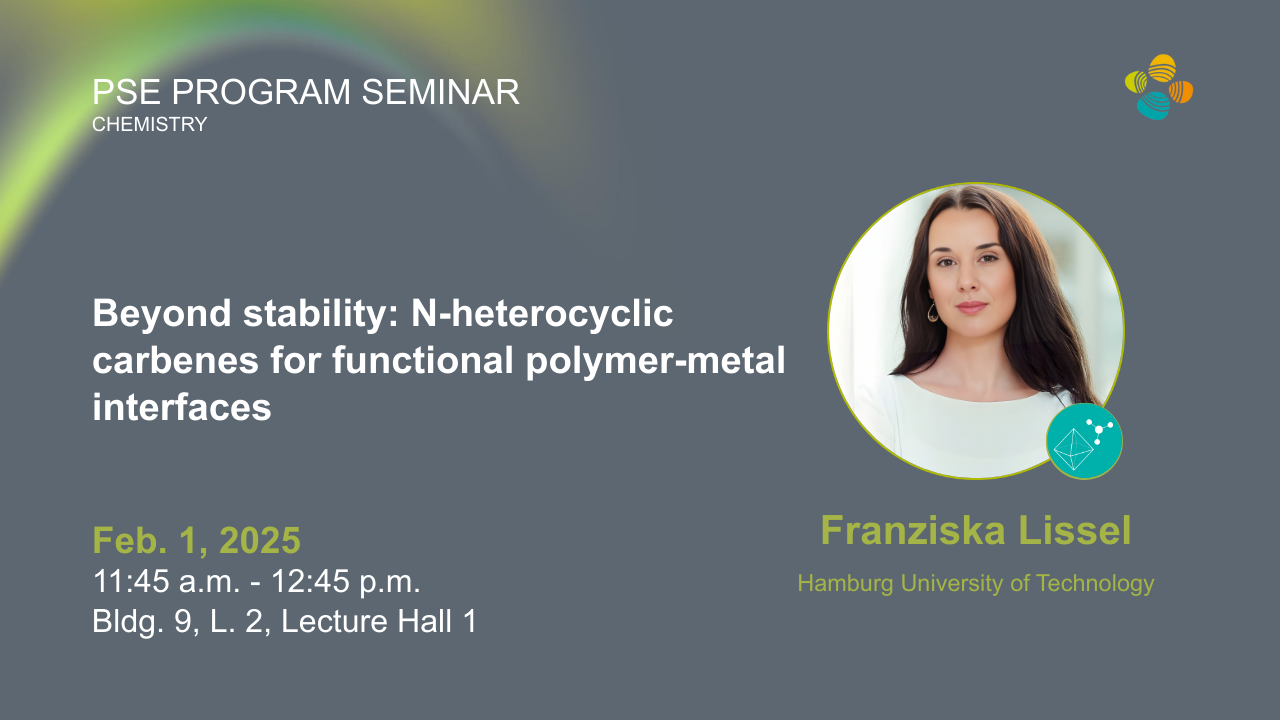
Beyond Stability: N-Heterocyclic Carbenes for Functional Polymer-Metal Interfaces
Abstract
The speaker's research addresses functional electronic materials using a materials-first approach that connects molecular structure and processing to electronic function and manufacturable device performance.
Within this context – spanning soft polymer electronics, functional hybrid interfaces, and molecular machines – the talk focuses on N-heterocyclic carbenes (NHC) as electronic bridges that govern charge transport across gold–polymer interfaces.
The talk presents recent work on gold-polymer hybrid nanoparticles in which NHCs form covalent, electronically coupled junctions between the gold core and the surrounding polymer shell. While NHCs are well established as highly stable ligands for gold, their role in mediating interfacial charge transport has remained largely unexplored experimentally. Two complementary synthetic approaches are discussed:
Direct reduction methods yielding ultrasmall, strongly coupled nanoparticles, and ligand-exchange strategies that introduce NHCs onto preformed gold nanoparticles with well-defined core sizes. Subsequent polymer growth affords core-shell architectures with tunable shell thickness and controlled interparticle coupling. Electrical measurements on assembled monolayers reveal pronounced enhancements in both vertical and lateral conductance compared to non-carbene-linked systems, together with fast and stable electrochromic responses, demonstrating efficient charge delocalization across carbene-based gold-polymer interfaces.
Taken together, these results establish NHCs as a chemically robust and scalable platform for engineering functional hybrid interfaces, while simultaneously highlighting clear pathways toward translation into printable interlayers and conductive inks for electronic and electrochromic devices – an aspect that is central to the speaker's broader research program.
Biography
Franziska Lissel is the Ingeborg-Gross Endowed Professor and Chair of the Institute of Applied Polymer Physics at Hamburg University of Technology (TUHH) and heads the Department of Sustainable Polymer Electronics at the Leibniz Institute of Polymer Research (IPF). Her research focuses on functional electronic materials, including soft and sustainable polymer electronics (intrinsically stretchable and recyclable polymer (semi)conductors), functional interfaces and hybrid materials (notably N-heterocyclic carbene–linked metallic nanoparticles), and electrically responsive molecular machines with controlled nanoscale mechanical function.
She was previously a postdoctoral scholar in Chemical Engineering at Stanford University with the Bao Research Group. She earned her Dr. sc.
nat. (Ph.D.) from the University of Zurich under Prof. Heinz Berke, in collaboration with Dr. Heike Riel’s group at IBM Research, and was affiliated with ETH Zurich. She studied biology and chemistry at the University of Bremen, earning a Diplom-Chem. (M.Sc. equivalent).
Prof. Lissel is a member of two DFG Clusters of Excellence (BlueMat and
REC2) and serves on the Board of BlueMat. She is a PI on two European Innovation Council Pathfinder projects (FITNESS and ESiM). Her work ihas been supported by competitive fellowships and grants, including from SNSF and SCNAT, and she collaborates with industry partners such as Procter & Gamble, Samsung, and Schill + Seilacher.