Jan 2026
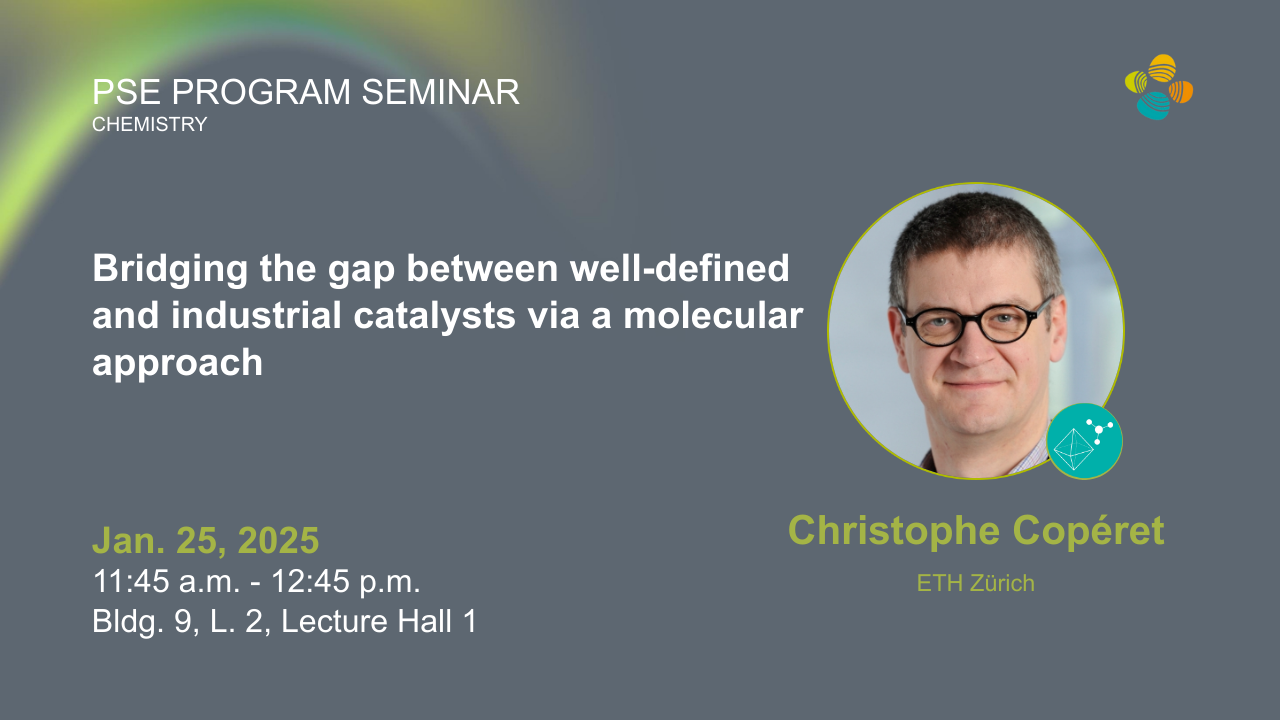
BRIDGING THE GAP BETWEEN WELL-DEFINED AND INDUSTRIAL CATALYSTS VIA A MOLECULAR APPROACH
Abstract
Industrial processes, in particular large-scale ones, mostly rely on heterogeneous catalysts. The search for more sustainable processes and the changes in environmental policies impose the continuous development of improved catalyst performances and catalytic processes, as well as the exploration of alternative routes. However, due to their inherent complexity, heterogeneous catalysts are mostly developed empirically rather than through detailed structure – activity relationships as the nature of the active sites are rarely known.
In this context, our group has been interested in understanding and controlling chemistry on surfaces, with the ultimate goal to generate isolated metal sites with defined chemical environment.[1] This approach has been used to develop highly active and selective single-site catalysts that can overperformed their homogeneous counterparts, but it can also provide useful information to understand and further develop industrial catalysts[2] or to study much more complex systems such as supported nanoparticles, where support effects, interfaces, alloying… remain complex to understand at the molecular level.
This lecture will be developed around these themes, focusing in particular on polymerization catalysts, and will show that a careful characterization of surface sites on a molecular level is key to develop high performance catalysts and to bridge the gap between fundamental and applied catalysis.[3]
References:
1 C. Copéret, A. Comas-Vives, M. P. Conley, D. Estes, A. Fedorov, V. Mougel, H. Nagae, F. Núñez-Zarur, P. A. Zhizhko Surface Organometallic and Coordination Chemistry towards Single-Site Heterogeneous Catalysts: Strategies, Methods, Structures, and Activities. Chem. Rev. 2016, 16, 323-421. DOI: 10.1021/acs.chemrev.5b00373
2 C. Copéret, F. Allouche, K. W. Chan, M. P. Conley, M. F. Delley, A. Fedorov, I. B. Moroz, V. Mougel, M. Pucino, K. Searles, K. Yamamoto, P. A. Zhizhko, Bridging the Gap between Industrial and Well-Defined Supported Catalysts. Angew. Chem. Int. Ed. 2018, 57, 6398-6440. DOI: 10.1002/anie.201702387
3 a) C. Copéret Single-Sites and Nanoparticles at Tailored Interfaces Prepared via Surface Organometallic Chemistry from Thermolytic Molecular Precursors. Acc. Chem. Res. 2019, 52, 1697-1708. DOI: 10.1021/acs.accounts.9b001388. b) Deciphering Metal-Oxide and Metal-Metal Interplay via Surface Organometallic Chemistry: A Case Study with CO2 Hydrogenation to Methanol. S. R. Docherty, C. Copéret J. Am. Chem. Soc. 2021, 143, 6767–6780. DOI: 10.1021/jacs.1c02555. c) Heterogeneous Alkane Dehydrogenation Catalysts Investigated via a Surface Organometallic Chemistry Approach. S. R. Docherty, L. Rochlitz, P.-A. Payard, C. Copéret Chem. Soc. Rev. 2021, 50, 5806 – 5822. DOI: 10.1039/d0cs01424a.
Biography
Prof. Christophe Copéret (CCH) was trained in chemistry and chemical engineering (CPE-Lyon, France, and carried out a PhD with Prof. E.i. Negishi (Purdue University,), where he investigated the synthesis of complex molecules via Pd-catalyzed carbonylation reactions. After a postdoctoral stay with Prof. K.B. Sharpless (Scripps), CCH entered CNRS in 1998 and was promoted CNRS Director in 2008. Since 2010, CCH is Professor in the Department of Chemistry and Applied Biosciences, ETH Zürich, and is an Associate Editor for JACS since 2022. Prof C. Copéret is an elected member of the Academia Europaea and Swiss Academy of Engineering Sciences (SAWT).
The scientific interest of CCH lies at the frontiers of molecular, material and surface chemistry as well as NMR spectroscopy with the aims to understand the electronic structure and design molecularly-defined heterogenous catalysts.
Webpage: http://www.coperetgroup.ethz.ch