Oct 2025
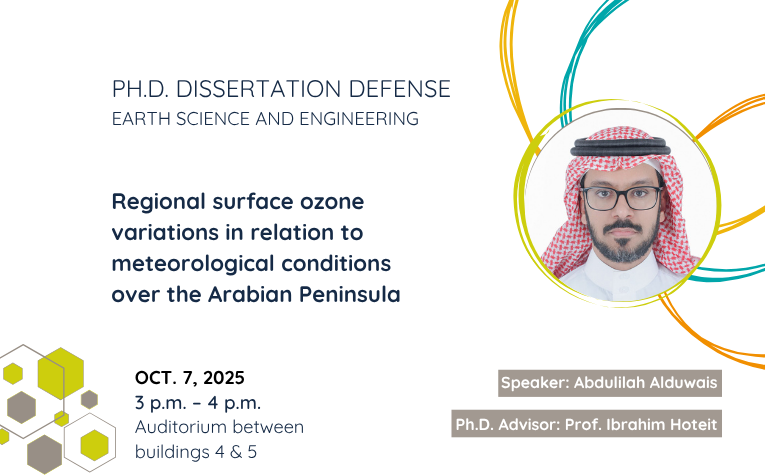
Regional surface ozone variations in relation to meteorological conditions over the Arabian Peninsula
Committee Members Information
- Ph.D. Advisor Name: Ibrahim Hoteit
- External Examiner Name: M. Venkat Ratnam
- Committee Chair Name: Pascal Saikaly
- 4th Committee Member Name: Hussein Hoteit
Zoom link: https://kaust.zoom.us/s/8439359006
Abstract
Surface ozone (O3) is a major air pollutant in the ambient atmosphere, causing significant health and environmental impacts, including respiratory complications, vegetation damage, air quality degradation, and material deterioration. Extensive research has been conducted globally to understand surface O3 formation in relation to its precursors and its interactions with meteorological parameters. However, research on the Arabian Peninsula remains limited, despite the Arabian Gulf being a recognized hotspot for photochemical O3 production.
This dissertation presents a comprehensive analysis of surface O3 variability in relation to meteorological conditions across the Arabian Peninsula, with a focus on the Arabian Gulf. It integrates ground-based observations, satellite data, reanalysis products, and modeling techniques. First, spatial and temporal patterns of surface O3 across the Arabian Peninsula are examined, revealing consistently high concentrations in the eastern region—particularly over the Arabian Gulf—driven by meteorological factors and large-scale circulations, especially in summer. Second, the analysis of extreme surface O3 episodes over the Arabian Gulf shows that most events occur during summer and persist for several days due to meteorological anomalies. Third, nocturnal surface O3 enhancements in Riyadh, Kingdom of Saudi Arabia (KSA), are investigated, revealing that the highest enhancements are associated with local and long-range transport from polluted regions and stratospheric intrusion zones. Lastly, the dry deposition of O3 during summer extremes observed in Riyadh, KSA and Manama, Bahrain, are estimated using modeling techniques, highlighting the role of dry deposition in reducing O3 mass. The performance of the model is investigated and compared with global estimates to assess the model ability to quantify O3 concentration while accounting for dry deposition.
This research establishes a foundation for surface O3 studies in the Arabian Peninsula through providing critical insights into the factors driving its variability and supporting future atmospheric research in the region.