Oct 2025
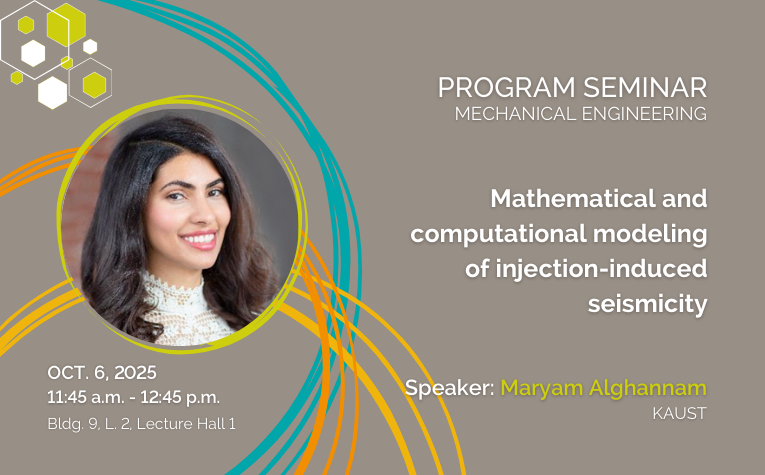
Mathematical and computational modeling of injection-induced seismicity
Abstract
Induced seismicity is a central issue in the development of subsurface energy technologies around the world. Examples include wastewater injection, geologic carbon sequestration, and geothermal energy extraction. In this talk, I present a poroelastic spring-slider model of frictional slip as an analog for induced seismicity to explain the common observation that abrupt increases in injection rate increase the seismic risk. I also present an energy analysis using the same model to shed light into the partitioning of energy released and its potential for damage to human-made structures. This work enhances our understanding of the mechanics of fluid-injection-induced earthquakes, and suggests strategies that mitigate or minimize the seismic risk associated with subsurface operations.
Biography
Maryam Alghannam is the Ibn Rushd Assistant Professor of Earth Systems Science and Engineering at KAUST and principal investigator of the Fault Poromechanics Lab. She holds a PhD in Computational Science and Engineering from MIT, an MS in Civil and Environmental Engineering from UC Berkeley, and a BS in Petroleum Engineering from Texas A&M University. Before academia, she worked as a reservoir engineer at Saudi Aramco and later as a postdoctoral fellow at Caltech. Her research focuses on fluid–fault interactions in the subsurface, with applications to induced seismicity and geothermal energy. She is the recipient of the George Housner Fellowship from Caltech, the Ibn Rushd Award from KAUST, and Advanced Degrees Fellowships from Saudi Aramco. Her work has been published in leading journals such as Nature Communications and Journal of the Mechanics and Physics of Solids and presented at major international conferences.