Oct 2025
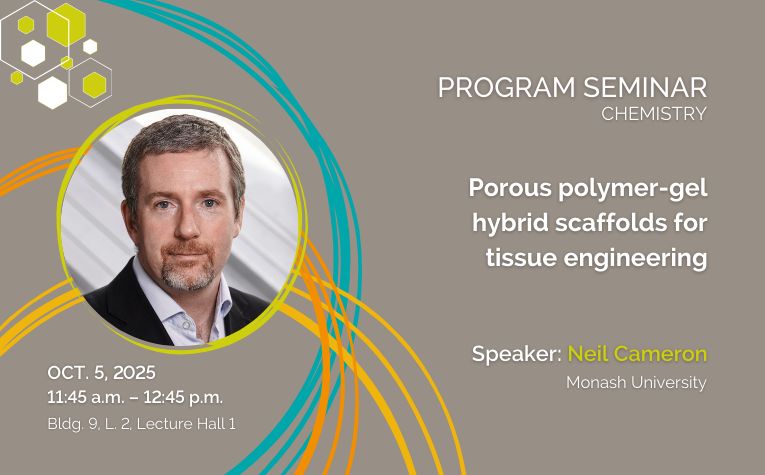
Porous polymer-gel hybrid scaffolds for tissue engineering
Abstract
Tissue engineering is a multidisciplinary field that combines principles of engineering, biology, and material science to create functional and viable biological tissues for medical applications. It involves the use of scaffolds, cells, and bioactive molecules to regenerate, repair, or replace damaged or diseased tissues in the human body. The ultimate goal of tissue engineering is to develop innovative strategies that can restore normal tissue function, offering potential solutions for a wide range of medical conditions, from organ failure to traumatic injuries. This cutting-edge field holds great promise for revolutionizing regenerative medicine and improving the quality of life for patients in need of tissue replacement therapies.
In the presentation, I will discuss our recent work on the development of composite scaffolds containing porous polymers and hydrogels, for tissue engineering applications. The gel phase consists of gelatin methacrylate (GelMA), which has emerged in recent years as the most commonly used bio-ink in 3D bioprinting due to its ease of production, suitable mechanical properties and the suitable microenvironment it creates for cell expansion and function. GelMA is combined with a variety of porous polymer scaffolds, including melt electrowritten polycaprolactone meshes and porous polymer granular scaffolds, to create scaffolds for use as 3D skin models and as injectable bone regeneration scaffolds. Other hybrid systems consist of photocurable resins that can be 3D printed or moulded into different shapes, which when combined with sacrificial 3D printed lattices result in scaffolds of hierarchical porosity for bone regeneration.
Biography
Prof. Neil Cameron has been the Monash Warwick Alliance Professor of Polymer Materials at the Department of Materials Science & Engineering, Monash University, since September 2014. During this period, he was Head of Department (2018-2024), and prior to his appointment at Monash he was a Professor in the Department of Chemistry at Durham University (UK), where he started as an Assistant Professor in 1997. He has a BSc and PhD from the University of Strathclyde (UK). His research is focused on the preparation of novel polymeric materials, with particular emphasis on scaffolds for tissue engineering, self-assembling polypeptides, peptide-synthetic polymer hybrids and sustainable polymer materials. His research has led to the publication of 200 papers (h-index 63; >16,000 citations) and he has given around 200 invited lectures at conferences and colloquia. He was awarded a DTI SMART Award (2001), the Macro Group UK Young Researcher’s Medal (2003), an ICI Strategic Fund Award (2004), a Durham University Christopherson/Knott Fellowship (2008) and he was a member of the team that won the RSC’s Rita and John Cornforth award (2011). He serves on the Editorial Advisory Board of the journals Polymer Chemistry and Polymer and is currently an Associate Editor for PLOS One. He is a member of the International Advisory Committee for the European Biomaterials Congress. He was Chairman of the RSC Macro Group (the UK society for polymer chemistry) from 2013-2016.